Showing posts with label History. Show all posts

Saturday, July 30, 2016

Thomas Cromwell Tracy Borman

This is a very fine history book. It is well researched, and very readable. It paints an honest picture, allowing the reader to make their own judgment on the man.
Thomas Cromwell. What a man. Certainly a man of ability whom Henry VIII described as 'the most faithful servant he had ever had.' Born in obscurity his hard work and ability raised him to Royal favour, to become the most powerful man in England after the King.
He reshaped the country, making Parliament more prominent, engineered the break with Rome, released the wealth of the monasteries for the benefit of the country, and placed a Bible in English in every parish in the land. A hero of the reformation.
For our generation, brought up on the film 'A Man for All Seasons' and a sympathetic Jean Plaidy novel of Sir Thomas More, Thomas Cromwell was the enemy, a scoundrel without principles and ruthless villain.  Hilary Mantel with her 'Wolf Hall' novels and TV adaptation have given us a new equally biased perspective, and Tracy Borman's book presents the facts as they are available to us, and an opportunity to make up our own mind.
The book is clear and well written. It does not zip along like a novel, and takes a bit more commitment than a well written historical novel. Two factors contribute to this; the quotations from source documents that are necessarily of a different style; and the retention of original spellings which require a little more concentration to follow; but the book is certainly the richer for that. I did not, as is sometimes the case, lose momentum and break off to read another book before finishing it.
There are two sets of pages with colour pictures of some of the main characters, which adds to the experience of the book.
My own opinion, having read the book, is that Cromwell was not a hero of the reformation, but paved the way for it. Where religious belief was heading at his death was very finely balanced, and what he did was possibly for more pragmatic reasons.
It was he that arranged for Ann Boleyn's death on largely false charges, and for Margaret Pole's death by Act of Attainder without any trial, which subsequently did for him. It seems he helped to create the bloody times he was part of. It is sad that a lawyer should have eroded individual civil liberties, but that is observed from the luxury of the present day.
It is clear that Cromwell inspired great loyalty from his friends, and Thomas Wyatt, poet and courtier, Ralph Sadler, trustworthy helper and able administrator, stand out as faithful friends who continued to enjoy Royal favour long after Cromwell disappereard from the scene.

Wednesday, May 23, 2012

Shap Abbey

The abbey was situated on the banks of the River Lowther

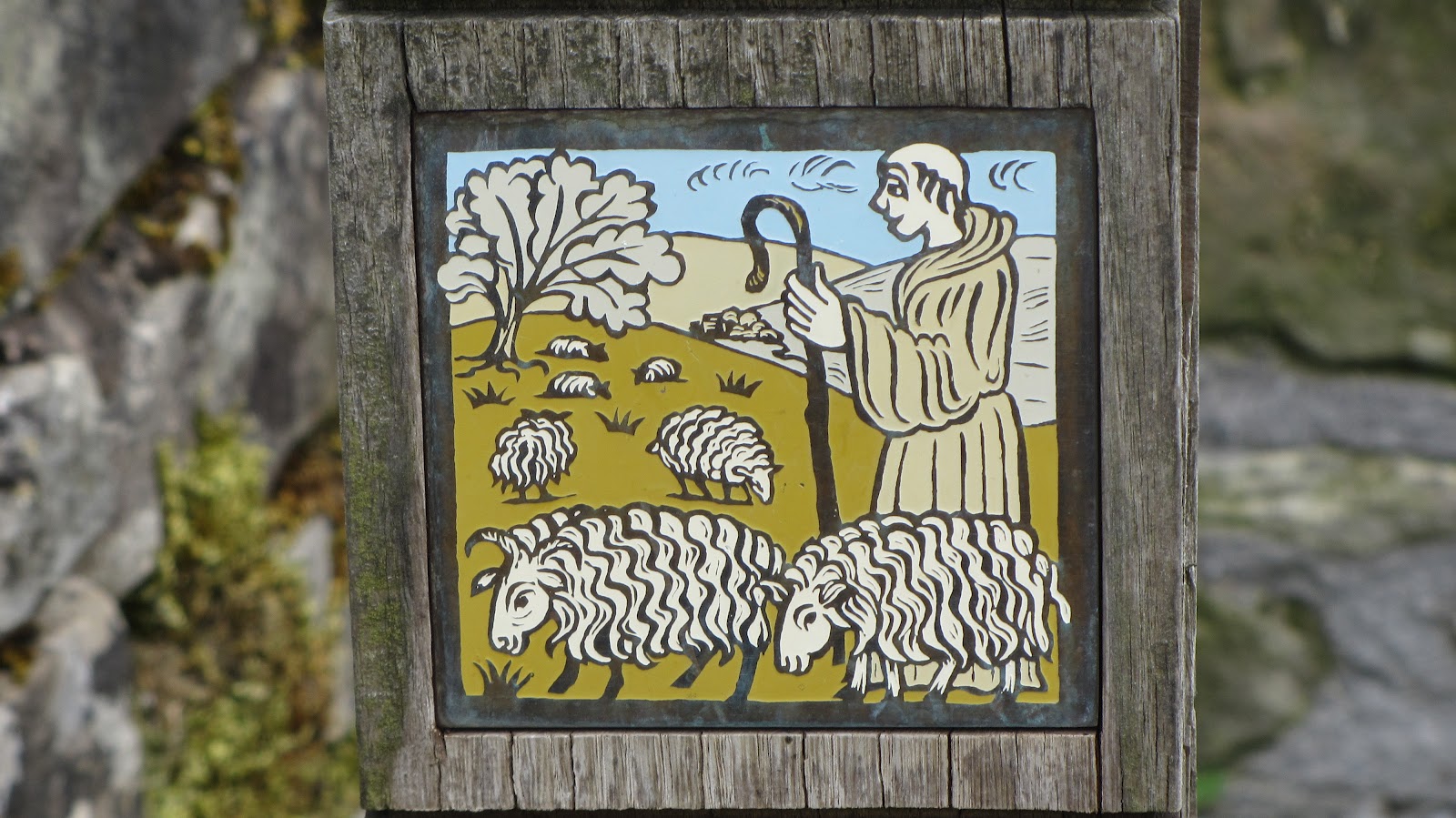
On the way from the car park to the abbey, a tile is set into a post y the bridge

Of all the buildings, only the tower is still standing

The River Lowther

The primroses on the river bank looked very fresh, even in May

The primroses enticed me onto the far bank for a close look

It was well worth clambering down from the path for a closer look at the Primroses on the river bank

The Abbey stood on the banks of the river

The tower is not what it was, but is still standing

Thursday, January 12, 2012

Decisions

I have discovered the secret of making decisions about important issues.

In section 133 of book one of the Histories, Herodotus writes of the Persians:-

They are extremely fond of wine... it is usual for them to be drunk when debating important issues. However, any decision they reach is put to them again on the next day, when they are sober, by the head of the household where the debate takes place; if they still approve of it when they are sober, it is adopted, but otherwise they forget about it. And any issues they debate when sober are reconsidered by them when they are drunk.


Tuesday, December 14, 2010

Lancaster Castle

There can rarely be an hour or five pounds better spent than the guided tour round Lancaster Castle.
It is a place of superlatives, the oldest prison still in operation, the oldest law courts, oldest prison cells, the records go on and on.  Being a law court, taking pictures was forbidden, not as matter of policy, but as a criminal offence.
We did not see much of the very oldest parts, from the time of King John, as the castle holds a working prison.  It is a small prison, a specialist centre for drug rehabilitation in the northwest, with a good record for low re-offending rates.
The Shire Hall is the jewel in the crown, built in Georgian times to house the civil court, and still in use today.  It is spacious, with rows of benches for competing teams of lawyers, and a large area for the jury to be comfortable during the long trials.  These are arranged in a semi circle and round them is an even wider terrace of seating for all the members of the public.  It is built like a theatre, because court cases were indeed a public spectacle in the eighteenth and nineteenth centuries.  When not being used as a court, the hall is used to stage plays and performances on occasions.
The semi circular back wall houses shields for every King of England from Richard I to Queen Elizabeth II. There are also smaller shields for other offices, including the Sheriff of Lancaster right up to the present day. The men and women who hold this office, for one year at time, display their ancestral coat of arms, if they have one, but mostly they need to design their own especially.
The room is light spacious and very pleasant, and we spent some time there being regaled by many interesting facts and anecdotes. I have no idea who the person in the left of three portraits hanging above the judges seats is, only that when I heard he was the second, I wanted to ask but never found a suitable moment - who was the first person to grow a pineapple in England?
The criminal court was a different affair, built in the older part of the castle, but with an impressive set of oak benches and panelling laying out the court room.  Again there was terraced public seating, but this was in a long hall, and the whole layout was more cramped. At the back of where the jury sat was a small door, through which a chamber pot could be passed, so that there was no need to delay proceedings if one of the jurors was caught short. At the back of the court the branding iron, used to mark the palm of those found guilty was still in place, long after it had ceased to be used.
On the way in to the court we passed through the jurors' waiting room, where they had the choice of the library or Star Trek videos to pass the time.  This is a pleasant Georgian room, made in the site of the much older court room, the very place where the Pendle witch trials of the seventeenth century were held.
The room where the jurors consider their verdict is a circular room, in one of the towers. It faces out of the castle into the public courtyard, and was used for public hangings in the past. It was all arranged so that hangings could take place in the rain without the executioner having to get wet.
We went into another tower, passing through a passage way cut through the ancient three foot walls, and sat in a circular room, and handled the irons used to chain men prisoners on their sixteen day walk to London before being deported to Australia. This particular ancient tower had a Georgian dome at the top, so as to fit in better alongside the Shire Hall.
The tour finished in another circular room in a tower, complete with a curved door, shaped after being made to fit the room by Robert Gillow, the famous furniture maker. Each of the chairs in this room were made by him, with individual faces carved at the top of each seat back.
Much of what we had seen was very impressive, but the tour was equally fascinating on account of the wealth of historical information and anecdotes that we were told along the way.