Saturday, August 20, 2011

Serita Cheeks

Last Monday a group of us went to see Serita Cheeks in concert at Nightnday cafe in Manchester.

We arrived in good time and got more than we bargained for as Serita was on after three other performers. They  probably got less than they bargained for, as besides groups that came to listen to other performers there were very few others in the venue that Monday night.
Rosie Dunn sang and played guitar, had a nice voice, and introduced each song, most of which she had written herself. The couple from Salt Lake City sang songs that were not to my taste, but they were great folk and it was good talking to them after their set. Judith Ude had an easy manner introducing hers songs, and a powerful voice with a touch of African sound, which came across very well in the songs she had written herself.
I was already familiar with some of Serita's songs, having bought then on iTunes. I was really glad to hear her in person, and enjoy her music much more than I did before.
She has a very distinctive voice, which the recordings do not fully do justice to, especially in the higher registers. Having now heard her sing live, I can pick out more of the qualities of her voice even in the higher notes, though the lower ones are reproduced with a richer in tone.
To say that Serita sings accompanied with guitar would be to downplay the guitar. Her guitar is as much part of the performance as her voice.  It sounded great when she was alone on the stage and even richer when she was joined by Simon Blake on the drums and Martin Ledger on base guitar. They had some good instrumental moments together which added to the evening. I have listened to the recordings quite differently since.
What stood out most about the live performance was the way Serita's voice blended with the instruments.  Her voice never overwhelmed the accompaniment as some of the other singers did, nor was it ever drowned out. It was always there, nicely in balance, giving a distinctive voice alongside the rich sound of the instruments.
Serita's songs are largely love songs that go down well in a music venue, without it being very obvious that they are worship songs, sung to God by one of his children.  The message is good, and the musicianship and performance added up to a great evening.

Thursday, June 30, 2011

Gershwin at the Phil

We were well entertained at the Liverpool Phil tonight.
Clark Rundell introduced an evening of Gershwin music. David was disappointed when he saw the orchestra, he was expecting Jazz, but as soon as the first chord from Strike up the band, he said "I didn't expect that" It was very good.  After two pieces they were joined by the pianist Stefano Bollani, who then rounded the first half off with some improvisations.
The piano had a mellow tone, and the first two solos were quite mellow. The last two had a brighter melody in the right hand with the left hand accompanying. He played a joke at the end, as we saw some of the humour we saw more of later.
After the break there was music from Porgy & Bess, which was great. There were some familiar tunes, and some beautiful lush sounds in places, and some faster parts. There were some false endings, big grand moments that seemed like a finale but were not.
Then came Rhapsody in Blue, played with improvisations, as it was by Gershwin.  It is a truly great piece, with dramatic variations of pace and volume.  How the orchestra coped with the variations of timing was amazing.  A few of us were on our feet with applause at the end.
They played an encore, piano and orchestra, and Stefano was following a score. I am not sure that he was playing from the score at all, but it all part of the entertainment. He kept playing as the orchestra walked off, and proceeded to entertain us with a variety of tunes, including a Beatles number

Thursday, June 02, 2011

Weekend at Grange

We went to Grange-over-Sands to see the Prom Art last weekend.  Every last Sunday of the month in the summer, people come and set up their tables and gazebos to sell their crafts. There was jewellery, cushions, glass ornaments, clocks, pictures. It was good to see the wares, and to talk to the people.   Ann's craft group are hoping to take part in it next month, so we took note of how people set out their stalls, and how they coped with the strong winds.

After some lunch we walked around the town and the ornamental park and admired the ducks before going to the Hazelmere Cafe for some Assam tea and a very gooey cake going b y the name of "The Beesting"
Ducklings by the lake
I bought a pair of trainers at a shop called Lancasters, and got them muddy straight away by walking out on the grass beyond the promenade.  After checking in at the B&B we drove up to Bowness on the Witherslack road, a very windy and isolated road running through beautiful woodland underneath Whitbarrow scar.  The day had brightened into a bright evening and it was very beautiful driving through the countryside.
Bowness turned out to be wall to wall bars restaurants and bistros - we might as well stayed in Liverpool. We drove on up to The Queen's Head in Troutbeck, and being very full of lunch and afternoon tea, we shared a main meal and cheese and biscuits, which did us very well.
The next day I enjoyed a full Cumbrian breakfast at Corner Beech House, with home made raspberry jam, before setting off for our visit to Holker Hall.  As we left Grange we drove down the Beech Hut gallery, where Ann bought a necklace made with coloured felt balls. We enjoyed a nice lunch at Holker Hall and bought some plants from their shop, and Wensleydale cheese from their food hall.
For all it being a bank holiday, the roads were not too crowded, and we were back home in less than two hours. We drove back through Grange, and the road into Grange from the West really does have some beautiful views across to Arnside, Silverdale, and Morecambe bay.  A great way to spend a bank holiday weekend.

Tuesday, May 31, 2011

Holker Hall

Holker Hall is a great place to visit, for the gardens and the house.
The house has two wings. The family live in the older, Tudor part, built by the Prestons and inherited by the Cavendish family, and the part we are shown round is the Victorian wing, rebuilt by the 7th Duke of Devonshire following a fire in 1871.
The rooms are large, spacious, and quite light. The oak is a mid oak colour, not yet aged very much.  Very little is roped off, as the rooms are used when not open to the public. There were five guides on duty, ready to talk about the rooms or answer any questions, or just leave you to absorb the atmosphere. There are many fine paintings and pieces of furniture, dating from before the Victorian era, brought by the Duke in the days when the house was part of the Chatsworth estate.  Lord Cavendish is second cousin to the 12th Duke of Devonshire.
We had already peeked into the library and drawing room, admiring the geraniums growing in the bay windows, as we walked in the gardens. Each had a desk placed in the bay window, making best use of the natural light, but the large windows gave both rooms a large bright and comfortable feel.  Even with every wall lined with books, the library felt like a living room.
The furnishings were bright and bold; blue sofas and curtains against deep red wallpaper in the drawing room, vivid green wallpaper in the billiard room, two heavy carved spiral columns either side of the dining room fireplace, but the rooms were large enough that it was not overwhelming.
You could imagine upstairs feeling like a comfortable family home. All the rooms were off a long gallery, with rocking horse and see-saw and card tables, as well as a real live fire in the fire place.  Each bedroom was a sizable living room, with fire and sofas and chairs. You could say that there were eight bedrooms rather than four, as each came with its own adjoining dressing room, where the valet or maid would sleep, ready to attend if needed.
In 1875 the house had all mod cons, including a bathroom. It may not have been used that much, as each bedroom had its chamber pot and wash stand.  Two rooms now have en-suite. One was made for Queen Mary in 1937, by dividing up the bathroom - she had a modern bath but the original WC and basin.  The other was added in 1939 when the Duke of Gloucester came to visit. In many ways the Duke's bedroom was best, being above the drawing room and having the same rounded bay window projecting from the corner of the house.
As well as the house there is the gardens. Next to the house is a formal garden with a fairly refreshing feel, having been laid out in 1993. That leads on to the summer garden, also laid out quite formally, with trees shaped very  square and severe. It feels quite architectural, but there is a lot of floral interest from the border on the long side nearest the house, backing onto the private garden. At the far end a corner gate leads to the rest of the gardens, and an end gate leads to the meadow, with wild flowers, a sundial and a labyrinth.
There is a fountain, at the foot of a cascade leading up to a statue of Neptune. The fountain is at a beautiful spot, surrounded by tall rhododendrons.  One of the famous features of the garden is the Holker Lime, which is certainly impressive for its girth, but we nearly missed it as we expected it to be freestanding. We ended up at the sunken garden, which was a very restful spot to enjoy the late afternoon sun.

Wednesday, May 25, 2011

Two Peas

Much of Fauré's Requiem is marked as pianissimo, but we are a small choir, and with few voices the choir director said we should sing it a little louder. She said we should take the two 'p's with a pinch of salt.

Tuesday, May 24, 2011

Winder Hill & Killington

I went up Winder Hill by Sedbergh ten days ago. I had forgotten to pack my walking boots, but my trainers were up to the task.

It was a gentle day. The second hand bookshop in Carnforth is good for maps, as the 4 lake district ones do not cover Sedbergh and the Howgills. I enjoyed a leisurely cup of coffee and Carnforth station, and considered a gentle walk along the Lune, but there was no very obvious place to park along the road from the M6 to Sedbergh.  I drove North of Sedbergh and enjoyed some great views over the river the Lune valley from the road up to Howgill, and then returned back to the centre of Sedbergh as there was no obvious place to park on the Howgill road either.
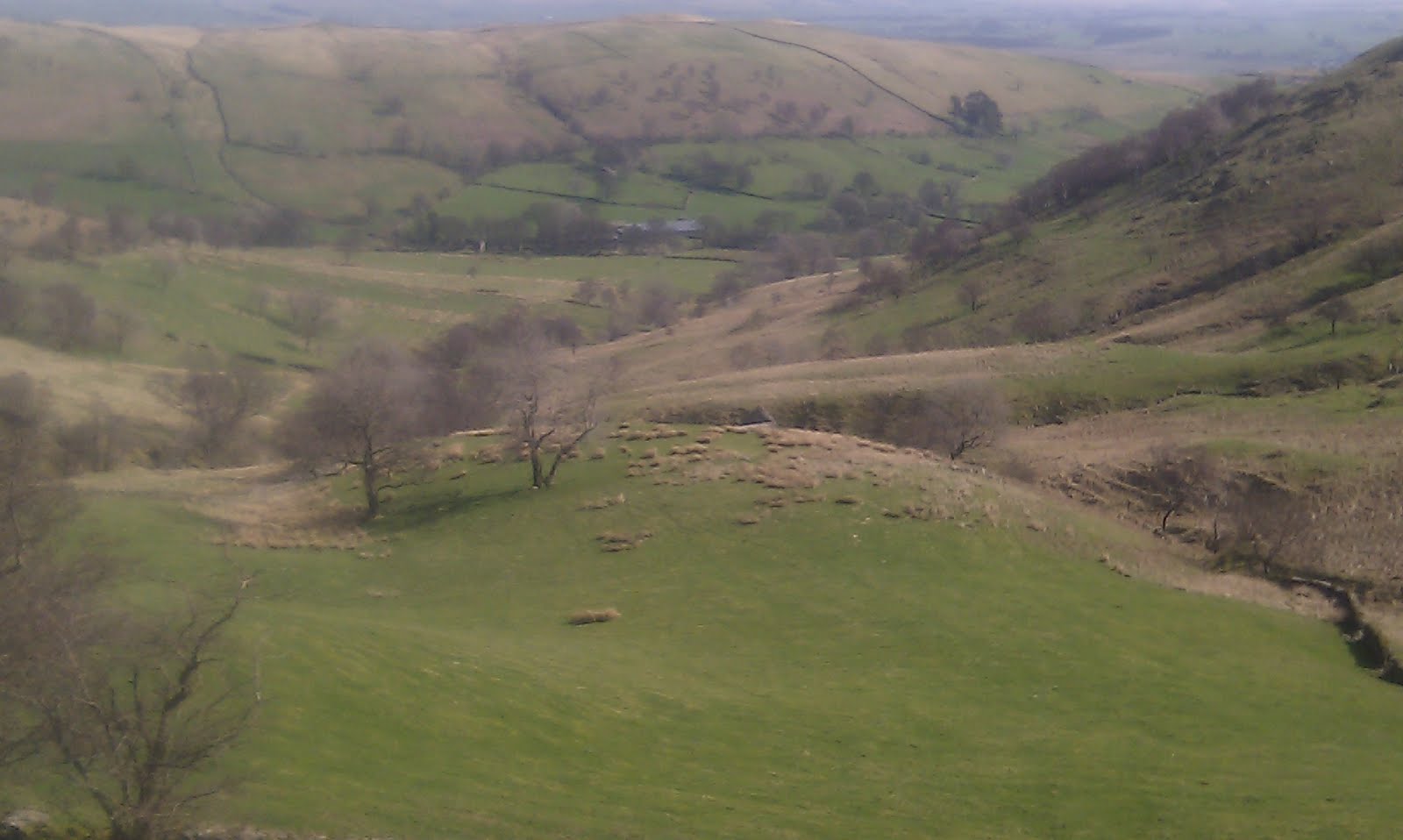
Winder Hill is access land, which means you can wander wherever, but the route up is marked by a closely cut grass path. Three paths meet at the top, two ascending from either side and one leading North to Bram Rigg and the Calf.  There are no rocky outcrops here, it is all grassy hills and valleys, with a gentle beauty.
There is a great view of the town of Sedbergh, which sits in a lush valley that widens out to the West to join the Lune valley running from North to South.  Looking East, you can pick out the Rawthey valley leading to Kirkby Stephen, the Gardsdale valley, leading to Wensleydale and Yorkshire, and the Dee valley, leading to Dentdale.
At the top, I saw a  group of two or three people a mile or so away to the North, but apart from that I did not meet anyone from leaving the road until rejoining it. Stopping on a bench to eat an apple, I did get overtaken by two walkers, they were part of a walking group from a church in Formby.
From the top I could see Morecambe Bay, and a little nearer, Killington Lake, but I could not see that anyone was sailing there.
There were people sailing at Killington on the Sunday.  Lancaster sea scouts were on Toppers, Sedbergh school were on a Laser 2000, and I made use of the club RS Feva.  The wind was quite strong, enough to bring a couple of wind surfers out, and with quite strong gusts forecast I thought the Feva would be easier to right and continue sailing than the Wayfarer. It certainly zipped along very nicely.

Saturday, May 07, 2011

Force 5 at Killington

Jeff and I had a great days sailing on Monday, with thanks to Dave for lending the wetsuit, and to Pete and Gareth for giving us the confidence.
Pete had been teaching some beginners in the high winds all weekend, but had reached the limit of what he could show them, and had decided to postpone for a quieter day when they would be able to take the helm. They were disappointed, and so were we as we hoped to have the benefit of them being on the lake. But Pete encouraged us, so with a reef in the mainsale, (thanks to Tony last week), the jib furled but ready for use if needed, and the centre board only half down, we set off to see how it went.
We were not alone on the lake, for as Pete and Gareth had predicted, the high winds did bring two windsurfers out. We were glad for their company and glad that there were other users on the lake.
The wind was strong and coming from the North East. I had only seen a northerly wind once before, on Easter Monday, but then it was nearer North, and was blowing down the channel on the other side of the island. This day the channel was in the lee of the island, and quite calm.
It was a great day sailing.  After some tacks to and fro across the lake we headed up wind, the north east corner seemed to need repeated short tacks to get there, but we managed it OK each time.
There was definitely less healing with less centreboard, but even so there were some interesting moments with the gusts.  With no jib, there was less for Jeff to do as crew, but he got the hang of moving about OK.  It was generally quite easy to see the wind direction from the waves, and the gusts from the darker patches of water, although sometimes the gusts started with a change in wind direction, causing the sale to flap before hitting it with force.
It was a sunny day, and when the wind eased off and we had time to look around there were some glorious moments, with the sun shining across the water.  We had two or three breaks, and I am glad to say I did a better job of brining the boat into the jetty that the previous week.  Most of the time we stayed fairly dry, but when the wind was at its strongest there were a few splashes coming over the bows, which added to the fun.


Toward the end of the afternoon, the wind grew stronger again, and it was even more of a struggle to keep the boat steady, so we came in and called it a day. A great Day.

Sunday, May 01, 2011

Easter Monday

On Easter Monday I went sailing at Killington with Chris and David.
We could see one boat already on the water as we left the motorway, but as we arrived Ian & Geraldine were just finishing, so we pretty much had the whole lake to ourselves.  There was one young lad getting a canoeing lesson, watched by his Dad, and we enjoyed the company of Jane, who was doing some repairs to her Laser in the clubhouse.  Later, Tony Longworth arrived to do some strimming around the grounds.
It was quite blowy, so we put a reef in the sail, not very expertly, and the sail creased badly and the boom was very low until Tony showed us how to tie the clew to the outhaul first, and round the boom if at all afterwards.
Given the wind conditions, David decided that reading in the fresh air or in the clubhouse was better than sailing, though after we came in for lunch the wind dropped a little, and he was enticed out, and quite enjoyed it.
I need more practice at coming into the jetty, and after one near miss turned round and ended up being hit on the head by the head as we jibed.  Thankfully this was when Tony was there and he talked me through the next approach, steering three boat lengths downwind of the jetty before turning to wind.
With the sail set better and the boom higher things felt much better, and Chris took the helm and did very well. It was after that when I was helming that we had a particularly strong gust, and we stayed upright by letting go of the tiller and sheet, effective but not very good at keeping control. There was quite a bit of water beneath the floor boards after that.
We have no pictures to show, although I brought a camera we never took it out, partly because it was quite busy sailing and partly because there were no other boats on the lake. Still a good days sailing.  A rare day, a force 3 coming from the North.

Monday, April 25, 2011

First Sailing

The weekend of 9th & 10th April was my first weekend with the Wayfarer. It took about an hour to set up the floorboards and seating. During this time the Lasers were getting set up ready for the open races. It was a fine sight seeing 21 lasers altogether on the water.
I was sailing with Greg, Jack Lawson's racing partner, who did not want to race Lasers until he got his own boat repaired, and he helped me get the boat rigged, showing me how to put a double purchase on the halyards.  After the first ten minutes getting the feel of the boat, I let Greg helm, which he did very well, inspiring confidence. After lunch we had two extra people, Richie, who had come to watch his son race, and Karen, Greg's mother. It could have been awkward but it wasn't, all credit to Greg. He sat well back in the boat, accommodating three crew much better than I managed last summer. We kept out of the way of the race, but sailed behind the starting line for the last race. Pete Lawson did not come first, but was beaten by his brother, David. We sailed close to him at one point, and admired his concentration and how level he kept the boat.

When I arrived on Sunday morning the lake was as flat as a pancake, good for the canoeists, but not for sailing so I drove up the M6 to Tebay, and to Bretherdale, parking near where the road becomes a track and forks in two.


I took the left hand fork called Breasthigh Road, which crosses the ridge and looks down at the A6 and Borrowdale. The hills the other side of Borrowdale looked inviting. I stopped at the top and looked down before retracing my steps back to the car.  At the start I saw some folk on trail motorbikes, and on the ridge I met two cyclists, aiming to complete 30 miles with lost of hills in one day, but apart from that I did not meet anyone.


I drove back on the minor road on the other side of the valley from the Motorway, and got some great views of the River Lune, before crossing the river at a very narrow bridge at Beck Foot.


When I got back to Killington the wind was a little more promising, and I had a an hour or two sailing in light winds to enjoy before packing up and coming home.

Sunday, April 24, 2011

Moon - The Film

This is an eerie film.
On earth life is good, with limitless energy, harvested from solar flares (don't try and follow the pseudo-science) but the arrangements come at some cost. On the moon, Sam Bell is two weeks off the end of his three year tour of duty.  Quite alone, apart from a robot called GERTY, voiced by Kevin Spacey, the isolation is the worse for having no direct communication with earth, watching only pre-recorded video clips.
We see Sam scald his wrist when distracted by a hallucination, and as Gerty applies a bandage, the robot challenges his explanation that he was distracted by the TV. The robot challenging the human is quietly threatening, but this is not 2001 A space odyssey, where Hal the computer turns against the humans. Gerty stays true to his programming of helping Sam, even when it involves breaking company protocols.
As you begin to appreciate the setup, you wonder what happens if Sam is injured away from the home station, attending the  harvesting machines. We do not have to wait long, before that is exactly what does happen.  It is after that that the film start to get really eerie.

Wednesday, March 23, 2011

St Sunday Crag

On Sunday I climbed St Sunday Crag. It was cloudy, drizzly and windy at the top, so not much of a view, but there were some great views of Ullswater on the way up. I started at Patterdale, and took the path past the public toilets into Grisedale.

Stepping Stones across the stream
 The path follows the contours to cross a stream by some stepping stones, and after that there appeared to  be a path leading up to the area marked Glenamara park on the map.  The next path the the left was the one I took, a steep climb onto the lower end of the ridge, followed by a more gentle section before it began to rise steeply again.
There were some great views of Ullswater on the climb up
From here you could look across Grisedale at pick out the familiar path that leads up the other side of the valley to Hole in the Wall and Striding Edge.
On the way up I met three guys who had camped at the top overnight. They warned me to expect it to be drizzly and grey at the top. They also said that Fairfield, at the far end was very slippery from the snow, as well as in cloud, so I reckoned by then to either retrace my steps or come down into Grisedale. Then I passed a group of three who were doing that route, down by Grisedale Tarn.
There was snow at the top
The steepest scramble came soon after that, and then there was a long section with a gentle wide path, along the top of the ridge with, presumably, very good views on a good day. After the peak, which is 841 meters and called The Cape, the ridge sloped very gently downwards, and became more narrow. Nothing like Striding Edge, but you could see the ground sloping away gently on both sides, and I would love to see it in a good day.
The path down to Grisedale Tarn was quite easy to spot, and marked with a small cairn, and at the point where the path started to rise again over the section called Deepdale Hause, which I left for a brighter day.  The path down was steep at first, and quite distinct, until I was quite close to the stream, where I missed it in the mist and cloud.
I did not want to take the map out of the pocket to change the fold, so I ended up following the stream down the valley, but looking at the map now I would have done better to walk up the stream to the tarn, and find the path.  I was glad when I was out of the cloud and could enjoy the impressive outcrops of rock on the Helvellyn side of the valley.  Then further down it was great looking up at St. Sunday Crag and thinking - I have been up there.

Glenridding in March

I called in at Glenridding Sailing School on Saturday. It was great to see many of the folks. Both my instructors from 2009 were there, Pete had brought someone to the first aid course for instructors, and Neil had brought his RS Vision there for the season.  Another couple had brought their Swift 18 for the season.  It looked very impressive, an 18ft yacht with a retractable keel.
The first aid course was taking place in the new block - a classroom, office, plumbed in toilets changing rooms with a shower. It was all very impressive.
Tom was there with his Nimrod, another boat with a retractable keel. Like last year in March, he took me out in it, and it was great. It felt so good to be out on the water again.
There was a mixture of clouds and sunshine, and the hills and and water looked great and as the light and shade was constantly changing the colours around us.
A couple had come from Lincoln to sail their Laser 3000, which looked great with its spinnaker up.  They had each fallen in multiple times, but were nicely warm in their dry suits. They were very exhilarated when they came in.
So thanks again to Tom, sailing without having to prepare for getting wet does have its attractions.

Sunday, February 27, 2011

Wansfell Pike

Last Sunday I climbed Wansfell Pike, walking from Troutbeck to Ambleside, and back through Skelghyll Wood.
I enjoyed a cup of coffee at the Queen's Head, Troutbeck, and considered walking north up the Troutbeck valley, but the ridge at the top, 784 metres was definitely in the low clouds. I was hoping that Wansfell Pike, 482 metres, might not be, but I was disappointed in that respect.
The path starts at Lanefoot farm on the B road that runs through the village from Town Head to Town End, and rises steeply at first, and flatten out as it joins a track called Nanny Lane.  This track runs North to a further peak slightly higher than Wansfell Pike, and there was a well signed turning to the left. The sign also requested walkers to keep to the path; good advice, as we were up in the clouds now, and the ground apart from the path was both boggy and snowy.
There were a few other walkers about, appearing through the mist. The gloves and hat, which had been consigned to the backpack during the sheltered early part of the climb were called back into service. At the very top the wind was biting cold on the bare skin, and I would have worn a balaclava if I had one.  There is a wall running North to South at the top, and it was more sheltered to the west of the wall, although the view was no better.
The path down to Ambleside was generally steeper, and very much so near the top. It was also much more busy, so there was quite a lot of waiting to pass as it was often only wide enough for one person.  Gradually the valley below became visible through the cloud, and eventually the path widened as it came down alongside a stream to reach a track, which led down into Ambleside.
During the descent there seemed to be a rather grand building, with orange windows, but when we passed it it turned out the orange was the boards over the windows of a university building no longer in use.
The road into Ambleside was now very busy, with pedestrians not traffic, because it is the route not only to Wansfell Pike, but also to the waterfalls of Stockghyll Force, a sight I left to another day.
While eating my lunch in Ambleside, I planned my route back, through Skelghyll Wood and Robin Lane back to Troutbeck.  A side road runs parallel to the A591, and just before this rejoins the main road, a path is sign posted to Skelghyll, Troutbeck and Jenkins Crag.
This is a pleasant walk, initially through woodland, and sheltered from the wind and with no threat of rain, the cagoule was packed away for the rest of the journey.
one boat under sail
Jenkins Crag is a short 50 yard detour off the main path. It was quite a surprise that the crag made such a good viewpoint, being in the middle of woodland. It gave a great view over Windermere, and I was impressed to see one boat under sail on the lake.
Further round, there were more impressive views looking South down Windermere seeing the Islands near Bowness in the distance.  I am looking forward to doing the walk on a brighter day.
All my way up this path, I passed people coming the other way that I had passed as they made their way up from Ambleside as I was making my way down, and some of them recognised me.It seems that a lot of people like to climb Wansfell Pike using the steep path, and then enjoy a more leisurely path down. Either they had been to Troutbeck, doing my route but in reverse, or they had turned South along the permissive path before they reached Nanny Lane.
There was one confusing point on the way back. The path joins a lane and following this will take you back along Skelghyll Lane through to Town End. I wanted the higher path that leads to Robin Lane, which meant turning off the lane. I avoided this at first thinking it was the path back up to Wansfell, but this was further on along the track called Hundreds Road.
Once on Robin Lane, there were benches at points along the way to enjoy the views, and it was a gentle walk down. The entrance to Robin Lane is signposted in Troutbeck, it is just past the post office.
So altogether a good walk, some steep paths, up and down, exposed hillsides, snow wind mist and cloud, as well as gentle paths and sheltered woodland.

Saturday, February 26, 2011

Scout Scar

Last Saturday I walked at Scout Scar, near Kendal.

It must be a great walk in good weather, with wonderful views, south as far as Arnside, and across the the fells on either side of Windermere. The snow on the hills to the North looked very enticing, but the rest of the view looked more eerie in the low cloud and mist.


It is very spectacular, the path runs along the cliff top, with gently sloping access land to the west, and a sharp drop to the East.
It is a very easy walk, just five minutes out of Kendal on the road to Underbarrow, there is a car park on the right, with a path leading to the left.  Because you start at the top of the ridge, there is no great climb before you are rewarded with great views.
I drove past the spot at first, and off to the right where I found a nice spot to eat my lunch in the car with a view of the Scar through the one window and of a waterfall in the other window.


Part way along the scar is a path that leads down to a farm at the foot of the cliff, which I took and walked on  to the village of Brigsteer.
This was a pleasant walk through a wooded area.
I did not look round the village but walked up a steep road to get back onto the access land at the cliff top again.  The road took me past signs to a church and a viewpoint, which I would have taken, if I had more time.
There were cattle grazing on the access land, but they seemed fairly unperturbed by my presence.  There are lots of paths across the land, but the only one marked took me to the foot of the cliff and up the route I had come down previously. I avoided that but did get tangled finding a style to cross the wall that runs right across the south end of the access land.
The weather had brightened up a bit by now, and the views were looking a little more inviting.

Wednesday, February 23, 2011

Hotel Comte

So, what about Hotel Comte in Rue de Dijon, Nice? Yes, I would stay there again, and I would recommend it, but look elsewhere if you want thick carpets and palatial rooms.  A studio flat was very satisfactory for the four of us for four nights at a total cost of €291.00.
The tariff was €70 per night for the flat, plus sales tax. I did think it was going to be €107.50 per night, with breakfast and car parking.  The hotel coffee did smell good as I went out to the nearby pattisserie to buy the pain au chocolate and pain au rasin, but we were very happy eating breakfast in the room, and the nearby car park turned out to be free on Sundays and overnight.
My first impressions were not good. I was dismayed for Kath, because there was a short but quite steep ramp at the front door, and our room was up a flight of stairs with no lift, but she did really well.  The rooms in the main part of the hotel did have lifts, but our flat was in the building at the back, along narrow corridors with light switches on timers. The flat itself had a living room with a table and two single beds, a separate bedroom about 9" longer than the bed.  The bath was too short to lie in and the shower was a hand held affair. There was a balcony looking over an untidy garden and looking over the car park.
For all the initial disappointment, it suited us very well. It was clean and comfortable, we got good nights' sleep. The kitchenette served us well for tea and coffee, and the table sufficed for breakfast and one of our four evening meals.
Our first problem was how to drive to Rue de Dijon in the hire car. We got this off to a tee by the end. From the Promenade des Anglais, the main road running from the airport to the town centre along the coast, turn onto Boulevard Gambetta, and keep going under the bridge that carries the main overhead dual carriage way from East to West. After a while the road forks to the left, or would do, except it is one way, and the next right turn is Rue Clement Roassal, which leads to Rue de Dijon.
Arriving by tram is even easier. It costs just one euro for any journey within 70 minutes however far you travel.  When you get off at Liberation, the hotel is in sight. Liberation square was a great place to be near, especially on Sunday morning. There were fruit stalls every morning, but on Sunday there were all sorts including a complete row of fish stalls.

We bought fruit not only to eat, but also to draw. On our evening in we used one of the pieces of paper that the food was wrapped in to draw a still life. Good times.

You can tell which is mine, it is the least artistic one.

Two of our three meals out were a very short walk away from the hotel, and Restaurant L'Instant on the first night was especially good and welcoming.

Wednesday, February 09, 2011

The Narnia Experience

You have ten days left to take your family to The Narnia Experience at St. George's Hall Liverpool.  It really brings the Lion the Witch and the Wardrobe story to life.
The entrance is at the Walker Art gallery end, and the air raid wardens are there to welcome you into war time London. There is music, a quiz, and a clip of the children being evacuated from London before you get taken to be briefed by the Professor's housekeeper, Mrs. Macready. Then the Narnian Dryad's come to lead you through the wardrobe, past the fur coats and into the magical world of Narnia.
This is St. George's hall as you have never seen it before. There is a snowscape (it is has been winter in Narnia for hundred years after all) forest (beware of the trees - some of them are spies, for the white witch) and a frozen waterfall with stepping stones.
There is good Narnian hospitality from Mr. Tumnus, the fawn, and Mrs. Beaver, in their cosy houses offering the best that Narnia has to offer. Edmund follows a slightly different route, which involves Turkish delight and the Queen of Narnia. The story moves on with film clips and live actors to Aslan's camp, the stone table, the witches castle and finally to Cair Paravel, where the sons of Adam and daughters of Eve are crowned Kings and Queens of Narnia.
Then it is back through the wardrobe door, to meet the Professor and make sense of it all, and onto the craft area, to make snowflakes and to talk to Aslan.  The whole experience takes about 90 minutes.
While you are in Narnia, you are guided round by Dryads, which was my part in the proceedings. It was good fun, and less lines to learn than Mr. Tumnus, Mrs. Beaver, or the White witch. It was great working with folk from various churches all over Liverpool. Well done to Annie Spiers and IAP for organising it.
Tickets from Ticketline

Saturday, January 22, 2011

Carcassonne Game

On Sunday our friends brought round the game Carcassonne that we had bought then for a recent birthday. It was great fun.
The play is not complicated. When it is your turn, you draw a card from the bag, and place it adjoining others on the table, then, if you want to, you place one of your free pieces on it. What gets complicated is the scoring, and the strategy.
The play continues until all the cards have been played. Then the points are totted up, and the player with most is the winner. Some of the points are awarded during play, and others are scored at the end.
Each of the square cards has four sides, surprisingly. These are either city, field, or road. When a card is placed each card it touches must have matching edges. Points are awarded during play when a city or road is completed. Points are awarded for fields and incomplete cities and roads at the end of play.
A piece with some city has a wall between the city and the field.  A city is bordered by wall and open sides. When there are no open sides and walls all join up, the city is complete. A piece may have 2 or 3 edges with city, useful for extending an existing city, or just one edge, useful for completing a city. A completed city can have just two pieces, or many. Some pieces have shields, which earn points, or other symbols which earn cards that may earn points at the end.
Roads all run in the fields, never in the cities. They terminate at cities, and they terminate at cross roads. A road is completed when it terminates at both ends. On the way it may run straight or turn corners.
A field is bounded by cities, roads and open sides.  There is no concept of a completed field, and points are awarded at the end rather than during play. Some pieces have four field sides, and a priory on it. This earns points for each of the eight adjoining pieces that are put in place.
You lay claim to a city road or field by placing one of your men in it.You can only place a man on a piece that you have just played. You can only lay claim to a city road or field that does not already belong to someone. That does not mean that no more than one person can own it, as two incomplete cities, each owned by different players may become joined, in which case the each own the city, and are awarded points when it is completed.
After placing a piece, you can put a man on the piece. If the piece has city and and road, you might put the man in the city, or on the road, or in one of the two fields on either side of the road, or you may chose not to place a man at all.
You have a limited number of men. Men placed in a field are there for the duration, but those placed on a road or city will get returned to you when the road or city is complete. As well as the men you have one pig, and one worker. You can place your pig in a field that you already own, and you get 5 instead of 4 points for each complete city in the field at the end of the game.  You can place the worker in any city or road that you already own. Subsequently, when you extend or complete that city or road, you have an extra turn. When the city or road is completed, the worker is returned to you with the man.
Two points are awarded for each piece being part of a completed city or road, and one point if it is incomplete at the end. There are also 2 or 1 point for each city piece with a shield.  A field is awarded 4 points for each completed city it borders, or 5 if there is a a pig as well as a man.  There are bonus points for having the most barrels and cotton collected when cities are completed.
So, do you place your men on cities fields or roads? Do you complete the city you own, or play the card elsewhere in the hope of extending the city later? I am looking forward to playing again to discover what kind of play does best.

The King's Speech

What an enjoyable film. There is no car chase here, the closest we get to that is a man walking in front of the car as it drives through the London Fog, I thought that was all over by 1936. There was no hurried moment and yet the interest and tension carried us for the full length of the film.
Of course, if you want tension, then talking on the wireless (nowadays we call it radio) to millions of people around the globe on the outbreak of war when you have a stammer ranks quite high.
The central relationship is between the Duke of York, who becomes King George V during the film, and Lionel Logue, an Australian speech therapist who helps him deliver his speech.  It is quite a stormy relationship at times.
In the therapy room, Lionel makes the rules. No smoking and strict equality, first names only (no one outside his family uses the name Bertie), are hard for the duke to come to terms with. The Australian has little reverence for the stone of Scone and regal trappings.
At other times the relationship is tender, as Lionel coaxes Bertie during the speech, or is there as Bertie talks about his childhood. Then sparks fly when the British establish discovers and takes exception to this colonial outsider. There is a lovely scene where Bertie tells Lionel he is being a coward.
Speech Therapy is portrayed as a mixture of exercises, some quite undignified, techniques, say apeople rather than people, helping people come to terms with trauma. I guess this combination helps to make it such a rewarding career option.
As well as all that you get George V, the rise of Hitler, Edward VIII, Wallis Simpson, the abdication and the outbreak of WWII.
Geoffrey Rush was good, Colin Firth was great, it was lovely to see Helena Bonham-Carter an an "English Rose", she was superb. Timothy Spall was a very creditable Winston Churchill, Derek Jacobi a very natural Archbishop of Canterbury.
The speech about being at war with Germany was accompanied by music by a composer who was.. German. Even so a good choice, Beethoven's seventh symphony added gravitas, and his 5th piano concerto afterwards reflected wonderfully how the speech had gone.   I regret to say I did not notice the other music, by Alexandre Desplat.  I will have to see the film again.

Sunday, January 16, 2011

Saturday, January 15, 2011

Woman in White

Back in the day, before mobile phones, before any sort of phones, you could send letters and know they would arrive the next day, and send messengers if the other person lived close enough.
The year was 1851, when a promise to be married to someone was not something you would contemplate reneging on just because you had fallen in love with some one else in the meantime.

The technology was different, some of the values were very different, but crime was still crime.  It's said that Woman in White, written by Wilkie Collins in 1861 was the first detective novel, but I think it is more than that. We are puzzled as the story plays out not by who did it? There is very little doubt who are the heroes and who are the villains. Rather we are intrigued in wondering what did they do? and how? and will there ever be proof?

The characters are closely observed and clearly drawn, but would you expect anything less from the drawing teacher who tells much of the narrative?   Actually the narrative is told by various characters, so there is a mixtures of styles and personal observations.  This adds to the feeling that you know the character of the various parties to the story.

Some of the minor characters tell their story in a way that is very comical, adding a touch of light relief to the story a it unfolds. The solicitor tells his part quite factually, but succinctly. His part is important, as property rights of women play as large a part in this as any Jane Austen novel.

Even with the change of styles, the story zips along and is quite readable; you get the story rather than commentary on the story and life in general that seem to make other 19th century novels hard going.

There is toward the end a very unexpected co-incidence of circumstances -  Ann used the word contrived - but the story is none the less good for that.

Indeed at the end all the loose ends are tied up, and we are left feeling good, and having enjoyed the company  of a wide selection of characters.