Monday, April 25, 2011

First Sailing

The weekend of 9th & 10th April was my first weekend with the Wayfarer. It took about an hour to set up the floorboards and seating. During this time the Lasers were getting set up ready for the open races. It was a fine sight seeing 21 lasers altogether on the water.
I was sailing with Greg, Jack Lawson's racing partner, who did not want to race Lasers until he got his own boat repaired, and he helped me get the boat rigged, showing me how to put a double purchase on the halyards.  After the first ten minutes getting the feel of the boat, I let Greg helm, which he did very well, inspiring confidence. After lunch we had two extra people, Richie, who had come to watch his son race, and Karen, Greg's mother. It could have been awkward but it wasn't, all credit to Greg. He sat well back in the boat, accommodating three crew much better than I managed last summer. We kept out of the way of the race, but sailed behind the starting line for the last race. Pete Lawson did not come first, but was beaten by his brother, David. We sailed close to him at one point, and admired his concentration and how level he kept the boat.

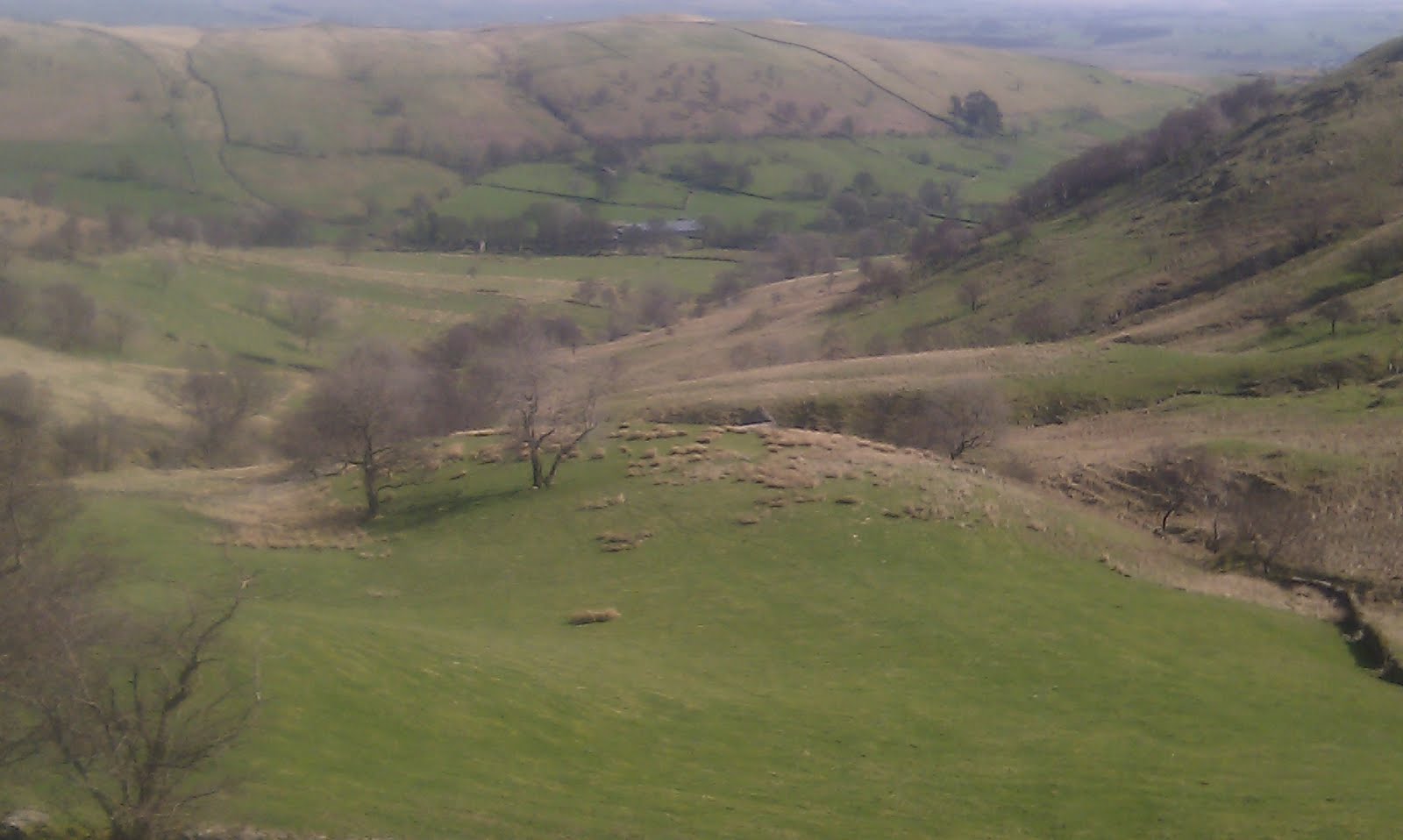
When I arrived on Sunday morning the lake was as flat as a pancake, good for the canoeists, but not for sailing so I drove up the M6 to Tebay, and to Bretherdale, parking near where the road becomes a track and forks in two.


I took the left hand fork called Breasthigh Road, which crosses the ridge and looks down at the A6 and Borrowdale. The hills the other side of Borrowdale looked inviting. I stopped at the top and looked down before retracing my steps back to the car.  At the start I saw some folk on trail motorbikes, and on the ridge I met two cyclists, aiming to complete 30 miles with lost of hills in one day, but apart from that I did not meet anyone.


I drove back on the minor road on the other side of the valley from the Motorway, and got some great views of the River Lune, before crossing the river at a very narrow bridge at Beck Foot.


When I got back to Killington the wind was a little more promising, and I had a an hour or two sailing in light winds to enjoy before packing up and coming home.

Sunday, April 24, 2011

Moon - The Film

This is an eerie film.
On earth life is good, with limitless energy, harvested from solar flares (don't try and follow the pseudo-science) but the arrangements come at some cost. On the moon, Sam Bell is two weeks off the end of his three year tour of duty.  Quite alone, apart from a robot called GERTY, voiced by Kevin Spacey, the isolation is the worse for having no direct communication with earth, watching only pre-recorded video clips.
We see Sam scald his wrist when distracted by a hallucination, and as Gerty applies a bandage, the robot challenges his explanation that he was distracted by the TV. The robot challenging the human is quietly threatening, but this is not 2001 A space odyssey, where Hal the computer turns against the humans. Gerty stays true to his programming of helping Sam, even when it involves breaking company protocols.
As you begin to appreciate the setup, you wonder what happens if Sam is injured away from the home station, attending the  harvesting machines. We do not have to wait long, before that is exactly what does happen.  It is after that that the film start to get really eerie.

Wednesday, March 23, 2011

St Sunday Crag

On Sunday I climbed St Sunday Crag. It was cloudy, drizzly and windy at the top, so not much of a view, but there were some great views of Ullswater on the way up. I started at Patterdale, and took the path past the public toilets into Grisedale.

Stepping Stones across the stream
 The path follows the contours to cross a stream by some stepping stones, and after that there appeared to  be a path leading up to the area marked Glenamara park on the map.  The next path the the left was the one I took, a steep climb onto the lower end of the ridge, followed by a more gentle section before it began to rise steeply again.
There were some great views of Ullswater on the climb up
From here you could look across Grisedale at pick out the familiar path that leads up the other side of the valley to Hole in the Wall and Striding Edge.
On the way up I met three guys who had camped at the top overnight. They warned me to expect it to be drizzly and grey at the top. They also said that Fairfield, at the far end was very slippery from the snow, as well as in cloud, so I reckoned by then to either retrace my steps or come down into Grisedale. Then I passed a group of three who were doing that route, down by Grisedale Tarn.
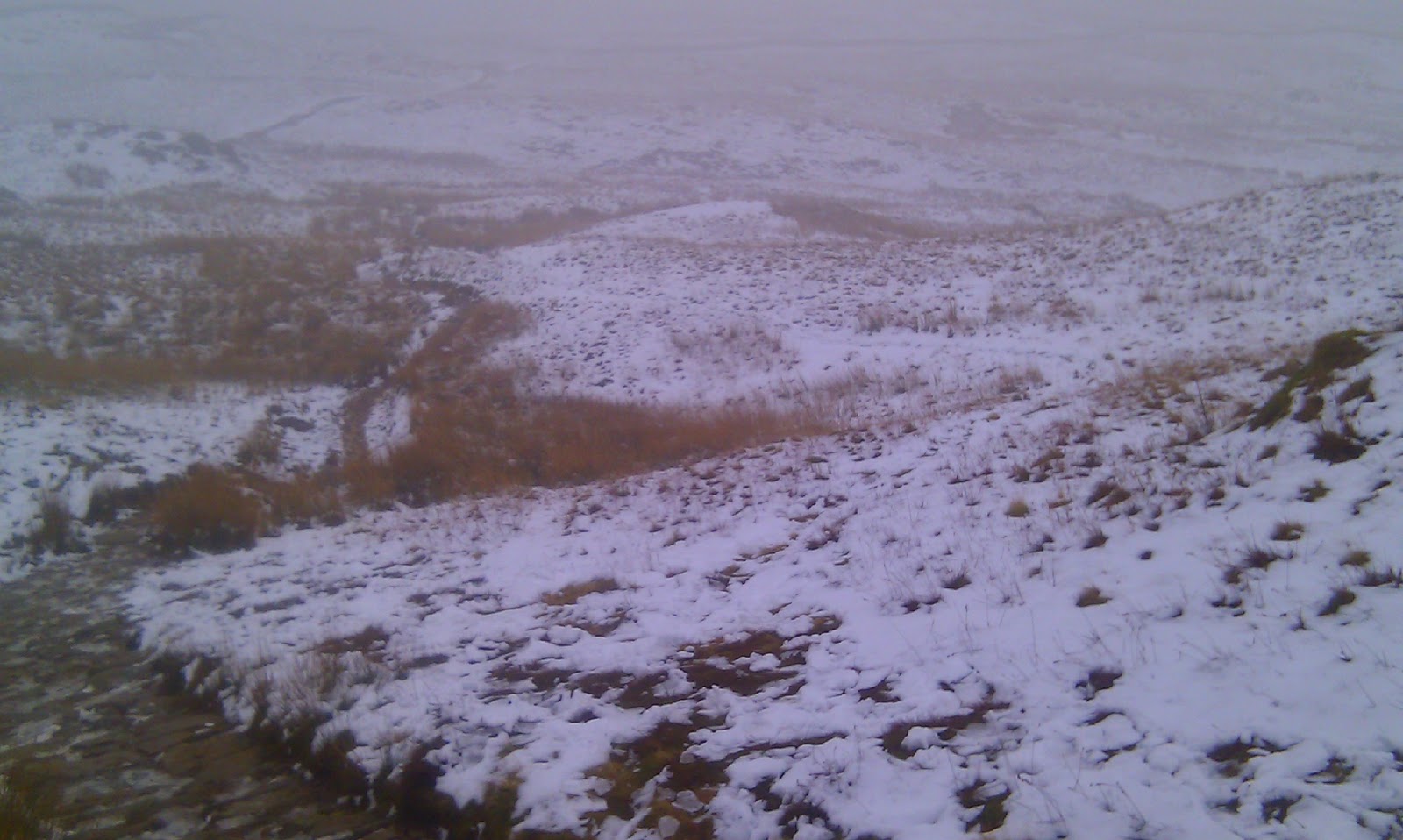
There was snow at the top
The steepest scramble came soon after that, and then there was a long section with a gentle wide path, along the top of the ridge with, presumably, very good views on a good day. After the peak, which is 841 meters and called The Cape, the ridge sloped very gently downwards, and became more narrow. Nothing like Striding Edge, but you could see the ground sloping away gently on both sides, and I would love to see it in a good day.
The path down to Grisedale Tarn was quite easy to spot, and marked with a small cairn, and at the point where the path started to rise again over the section called Deepdale Hause, which I left for a brighter day.  The path down was steep at first, and quite distinct, until I was quite close to the stream, where I missed it in the mist and cloud.
I did not want to take the map out of the pocket to change the fold, so I ended up following the stream down the valley, but looking at the map now I would have done better to walk up the stream to the tarn, and find the path.  I was glad when I was out of the cloud and could enjoy the impressive outcrops of rock on the Helvellyn side of the valley.  Then further down it was great looking up at St. Sunday Crag and thinking - I have been up there.

Glenridding in March

I called in at Glenridding Sailing School on Saturday. It was great to see many of the folks. Both my instructors from 2009 were there, Pete had brought someone to the first aid course for instructors, and Neil had brought his RS Vision there for the season.  Another couple had brought their Swift 18 for the season.  It looked very impressive, an 18ft yacht with a retractable keel.
The first aid course was taking place in the new block - a classroom, office, plumbed in toilets changing rooms with a shower. It was all very impressive.
Tom was there with his Nimrod, another boat with a retractable keel. Like last year in March, he took me out in it, and it was great. It felt so good to be out on the water again.
There was a mixture of clouds and sunshine, and the hills and and water looked great and as the light and shade was constantly changing the colours around us.
A couple had come from Lincoln to sail their Laser 3000, which looked great with its spinnaker up.  They had each fallen in multiple times, but were nicely warm in their dry suits. They were very exhilarated when they came in.
So thanks again to Tom, sailing without having to prepare for getting wet does have its attractions.

Sunday, February 27, 2011

Wansfell Pike

Last Sunday I climbed Wansfell Pike, walking from Troutbeck to Ambleside, and back through Skelghyll Wood.
I enjoyed a cup of coffee at the Queen's Head, Troutbeck, and considered walking north up the Troutbeck valley, but the ridge at the top, 784 metres was definitely in the low clouds. I was hoping that Wansfell Pike, 482 metres, might not be, but I was disappointed in that respect.
The path starts at Lanefoot farm on the B road that runs through the village from Town Head to Town End, and rises steeply at first, and flatten out as it joins a track called Nanny Lane.  This track runs North to a further peak slightly higher than Wansfell Pike, and there was a well signed turning to the left. The sign also requested walkers to keep to the path; good advice, as we were up in the clouds now, and the ground apart from the path was both boggy and snowy.
There were a few other walkers about, appearing through the mist. The gloves and hat, which had been consigned to the backpack during the sheltered early part of the climb were called back into service. At the very top the wind was biting cold on the bare skin, and I would have worn a balaclava if I had one.  There is a wall running North to South at the top, and it was more sheltered to the west of the wall, although the view was no better.
The path down to Ambleside was generally steeper, and very much so near the top. It was also much more busy, so there was quite a lot of waiting to pass as it was often only wide enough for one person.  Gradually the valley below became visible through the cloud, and eventually the path widened as it came down alongside a stream to reach a track, which led down into Ambleside.
During the descent there seemed to be a rather grand building, with orange windows, but when we passed it it turned out the orange was the boards over the windows of a university building no longer in use.
The road into Ambleside was now very busy, with pedestrians not traffic, because it is the route not only to Wansfell Pike, but also to the waterfalls of Stockghyll Force, a sight I left to another day.
While eating my lunch in Ambleside, I planned my route back, through Skelghyll Wood and Robin Lane back to Troutbeck.  A side road runs parallel to the A591, and just before this rejoins the main road, a path is sign posted to Skelghyll, Troutbeck and Jenkins Crag.
This is a pleasant walk, initially through woodland, and sheltered from the wind and with no threat of rain, the cagoule was packed away for the rest of the journey.
one boat under sail
Jenkins Crag is a short 50 yard detour off the main path. It was quite a surprise that the crag made such a good viewpoint, being in the middle of woodland. It gave a great view over Windermere, and I was impressed to see one boat under sail on the lake.
Further round, there were more impressive views looking South down Windermere seeing the Islands near Bowness in the distance.  I am looking forward to doing the walk on a brighter day.
All my way up this path, I passed people coming the other way that I had passed as they made their way up from Ambleside as I was making my way down, and some of them recognised me.It seems that a lot of people like to climb Wansfell Pike using the steep path, and then enjoy a more leisurely path down. Either they had been to Troutbeck, doing my route but in reverse, or they had turned South along the permissive path before they reached Nanny Lane.
There was one confusing point on the way back. The path joins a lane and following this will take you back along Skelghyll Lane through to Town End. I wanted the higher path that leads to Robin Lane, which meant turning off the lane. I avoided this at first thinking it was the path back up to Wansfell, but this was further on along the track called Hundreds Road.
Once on Robin Lane, there were benches at points along the way to enjoy the views, and it was a gentle walk down. The entrance to Robin Lane is signposted in Troutbeck, it is just past the post office.
So altogether a good walk, some steep paths, up and down, exposed hillsides, snow wind mist and cloud, as well as gentle paths and sheltered woodland.

Saturday, February 26, 2011

Scout Scar

Last Saturday I walked at Scout Scar, near Kendal.

It must be a great walk in good weather, with wonderful views, south as far as Arnside, and across the the fells on either side of Windermere. The snow on the hills to the North looked very enticing, but the rest of the view looked more eerie in the low cloud and mist.


It is very spectacular, the path runs along the cliff top, with gently sloping access land to the west, and a sharp drop to the East.
It is a very easy walk, just five minutes out of Kendal on the road to Underbarrow, there is a car park on the right, with a path leading to the left.  Because you start at the top of the ridge, there is no great climb before you are rewarded with great views.
I drove past the spot at first, and off to the right where I found a nice spot to eat my lunch in the car with a view of the Scar through the one window and of a waterfall in the other window.


Part way along the scar is a path that leads down to a farm at the foot of the cliff, which I took and walked on  to the village of Brigsteer.
This was a pleasant walk through a wooded area.
I did not look round the village but walked up a steep road to get back onto the access land at the cliff top again.  The road took me past signs to a church and a viewpoint, which I would have taken, if I had more time.
There were cattle grazing on the access land, but they seemed fairly unperturbed by my presence.  There are lots of paths across the land, but the only one marked took me to the foot of the cliff and up the route I had come down previously. I avoided that but did get tangled finding a style to cross the wall that runs right across the south end of the access land.
The weather had brightened up a bit by now, and the views were looking a little more inviting.

Wednesday, February 23, 2011

Hotel Comte

So, what about Hotel Comte in Rue de Dijon, Nice? Yes, I would stay there again, and I would recommend it, but look elsewhere if you want thick carpets and palatial rooms.  A studio flat was very satisfactory for the four of us for four nights at a total cost of €291.00.
The tariff was €70 per night for the flat, plus sales tax. I did think it was going to be €107.50 per night, with breakfast and car parking.  The hotel coffee did smell good as I went out to the nearby pattisserie to buy the pain au chocolate and pain au rasin, but we were very happy eating breakfast in the room, and the nearby car park turned out to be free on Sundays and overnight.
My first impressions were not good. I was dismayed for Kath, because there was a short but quite steep ramp at the front door, and our room was up a flight of stairs with no lift, but she did really well.  The rooms in the main part of the hotel did have lifts, but our flat was in the building at the back, along narrow corridors with light switches on timers. The flat itself had a living room with a table and two single beds, a separate bedroom about 9" longer than the bed.  The bath was too short to lie in and the shower was a hand held affair. There was a balcony looking over an untidy garden and looking over the car park.
For all the initial disappointment, it suited us very well. It was clean and comfortable, we got good nights' sleep. The kitchenette served us well for tea and coffee, and the table sufficed for breakfast and one of our four evening meals.
Our first problem was how to drive to Rue de Dijon in the hire car. We got this off to a tee by the end. From the Promenade des Anglais, the main road running from the airport to the town centre along the coast, turn onto Boulevard Gambetta, and keep going under the bridge that carries the main overhead dual carriage way from East to West. After a while the road forks to the left, or would do, except it is one way, and the next right turn is Rue Clement Roassal, which leads to Rue de Dijon.
Arriving by tram is even easier. It costs just one euro for any journey within 70 minutes however far you travel.  When you get off at Liberation, the hotel is in sight. Liberation square was a great place to be near, especially on Sunday morning. There were fruit stalls every morning, but on Sunday there were all sorts including a complete row of fish stalls.

We bought fruit not only to eat, but also to draw. On our evening in we used one of the pieces of paper that the food was wrapped in to draw a still life. Good times.

You can tell which is mine, it is the least artistic one.

Two of our three meals out were a very short walk away from the hotel, and Restaurant L'Instant on the first night was especially good and welcoming.

Wednesday, February 09, 2011

The Narnia Experience

You have ten days left to take your family to The Narnia Experience at St. George's Hall Liverpool.  It really brings the Lion the Witch and the Wardrobe story to life.
The entrance is at the Walker Art gallery end, and the air raid wardens are there to welcome you into war time London. There is music, a quiz, and a clip of the children being evacuated from London before you get taken to be briefed by the Professor's housekeeper, Mrs. Macready. Then the Narnian Dryad's come to lead you through the wardrobe, past the fur coats and into the magical world of Narnia.
This is St. George's hall as you have never seen it before. There is a snowscape (it is has been winter in Narnia for hundred years after all) forest (beware of the trees - some of them are spies, for the white witch) and a frozen waterfall with stepping stones.
There is good Narnian hospitality from Mr. Tumnus, the fawn, and Mrs. Beaver, in their cosy houses offering the best that Narnia has to offer. Edmund follows a slightly different route, which involves Turkish delight and the Queen of Narnia. The story moves on with film clips and live actors to Aslan's camp, the stone table, the witches castle and finally to Cair Paravel, where the sons of Adam and daughters of Eve are crowned Kings and Queens of Narnia.
Then it is back through the wardrobe door, to meet the Professor and make sense of it all, and onto the craft area, to make snowflakes and to talk to Aslan.  The whole experience takes about 90 minutes.
While you are in Narnia, you are guided round by Dryads, which was my part in the proceedings. It was good fun, and less lines to learn than Mr. Tumnus, Mrs. Beaver, or the White witch. It was great working with folk from various churches all over Liverpool. Well done to Annie Spiers and IAP for organising it.
Tickets from Ticketline

Saturday, January 22, 2011

Carcassonne Game

On Sunday our friends brought round the game Carcassonne that we had bought then for a recent birthday. It was great fun.
The play is not complicated. When it is your turn, you draw a card from the bag, and place it adjoining others on the table, then, if you want to, you place one of your free pieces on it. What gets complicated is the scoring, and the strategy.
The play continues until all the cards have been played. Then the points are totted up, and the player with most is the winner. Some of the points are awarded during play, and others are scored at the end.
Each of the square cards has four sides, surprisingly. These are either city, field, or road. When a card is placed each card it touches must have matching edges. Points are awarded during play when a city or road is completed. Points are awarded for fields and incomplete cities and roads at the end of play.
A piece with some city has a wall between the city and the field.  A city is bordered by wall and open sides. When there are no open sides and walls all join up, the city is complete. A piece may have 2 or 3 edges with city, useful for extending an existing city, or just one edge, useful for completing a city. A completed city can have just two pieces, or many. Some pieces have shields, which earn points, or other symbols which earn cards that may earn points at the end.
Roads all run in the fields, never in the cities. They terminate at cities, and they terminate at cross roads. A road is completed when it terminates at both ends. On the way it may run straight or turn corners.
A field is bounded by cities, roads and open sides.  There is no concept of a completed field, and points are awarded at the end rather than during play. Some pieces have four field sides, and a priory on it. This earns points for each of the eight adjoining pieces that are put in place.
You lay claim to a city road or field by placing one of your men in it.You can only place a man on a piece that you have just played. You can only lay claim to a city road or field that does not already belong to someone. That does not mean that no more than one person can own it, as two incomplete cities, each owned by different players may become joined, in which case the each own the city, and are awarded points when it is completed.
After placing a piece, you can put a man on the piece. If the piece has city and and road, you might put the man in the city, or on the road, or in one of the two fields on either side of the road, or you may chose not to place a man at all.
You have a limited number of men. Men placed in a field are there for the duration, but those placed on a road or city will get returned to you when the road or city is complete. As well as the men you have one pig, and one worker. You can place your pig in a field that you already own, and you get 5 instead of 4 points for each complete city in the field at the end of the game.  You can place the worker in any city or road that you already own. Subsequently, when you extend or complete that city or road, you have an extra turn. When the city or road is completed, the worker is returned to you with the man.
Two points are awarded for each piece being part of a completed city or road, and one point if it is incomplete at the end. There are also 2 or 1 point for each city piece with a shield.  A field is awarded 4 points for each completed city it borders, or 5 if there is a a pig as well as a man.  There are bonus points for having the most barrels and cotton collected when cities are completed.
So, do you place your men on cities fields or roads? Do you complete the city you own, or play the card elsewhere in the hope of extending the city later? I am looking forward to playing again to discover what kind of play does best.

The King's Speech

What an enjoyable film. There is no car chase here, the closest we get to that is a man walking in front of the car as it drives through the London Fog, I thought that was all over by 1936. There was no hurried moment and yet the interest and tension carried us for the full length of the film.
Of course, if you want tension, then talking on the wireless (nowadays we call it radio) to millions of people around the globe on the outbreak of war when you have a stammer ranks quite high.
The central relationship is between the Duke of York, who becomes King George V during the film, and Lionel Logue, an Australian speech therapist who helps him deliver his speech.  It is quite a stormy relationship at times.
In the therapy room, Lionel makes the rules. No smoking and strict equality, first names only (no one outside his family uses the name Bertie), are hard for the duke to come to terms with. The Australian has little reverence for the stone of Scone and regal trappings.
At other times the relationship is tender, as Lionel coaxes Bertie during the speech, or is there as Bertie talks about his childhood. Then sparks fly when the British establish discovers and takes exception to this colonial outsider. There is a lovely scene where Bertie tells Lionel he is being a coward.
Speech Therapy is portrayed as a mixture of exercises, some quite undignified, techniques, say apeople rather than people, helping people come to terms with trauma. I guess this combination helps to make it such a rewarding career option.
As well as all that you get George V, the rise of Hitler, Edward VIII, Wallis Simpson, the abdication and the outbreak of WWII.
Geoffrey Rush was good, Colin Firth was great, it was lovely to see Helena Bonham-Carter an an "English Rose", she was superb. Timothy Spall was a very creditable Winston Churchill, Derek Jacobi a very natural Archbishop of Canterbury.
The speech about being at war with Germany was accompanied by music by a composer who was.. German. Even so a good choice, Beethoven's seventh symphony added gravitas, and his 5th piano concerto afterwards reflected wonderfully how the speech had gone.   I regret to say I did not notice the other music, by Alexandre Desplat.  I will have to see the film again.

Sunday, January 16, 2011

Saturday, January 15, 2011

Woman in White

Back in the day, before mobile phones, before any sort of phones, you could send letters and know they would arrive the next day, and send messengers if the other person lived close enough.
The year was 1851, when a promise to be married to someone was not something you would contemplate reneging on just because you had fallen in love with some one else in the meantime.

The technology was different, some of the values were very different, but crime was still crime.  It's said that Woman in White, written by Wilkie Collins in 1861 was the first detective novel, but I think it is more than that. We are puzzled as the story plays out not by who did it? There is very little doubt who are the heroes and who are the villains. Rather we are intrigued in wondering what did they do? and how? and will there ever be proof?

The characters are closely observed and clearly drawn, but would you expect anything less from the drawing teacher who tells much of the narrative?   Actually the narrative is told by various characters, so there is a mixtures of styles and personal observations.  This adds to the feeling that you know the character of the various parties to the story.

Some of the minor characters tell their story in a way that is very comical, adding a touch of light relief to the story a it unfolds. The solicitor tells his part quite factually, but succinctly. His part is important, as property rights of women play as large a part in this as any Jane Austen novel.

Even with the change of styles, the story zips along and is quite readable; you get the story rather than commentary on the story and life in general that seem to make other 19th century novels hard going.

There is toward the end a very unexpected co-incidence of circumstances -  Ann used the word contrived - but the story is none the less good for that.

Indeed at the end all the loose ends are tied up, and we are left feeling good, and having enjoyed the company  of a wide selection of characters.

Friday, December 31, 2010

HTC Desire Annoyances

Make no mistake.  The HTC Desire is a great phone.  The annoyances are real, but they detract very little from the overall experience.
I will add to this post, the most recent comment was made 14 January 2011.
I am using Android version 2.2 (software number 2.29.405.5)

Calendar.
  • When on a month view, you swipe from left to right to move forward a  month, and right to left to move back. When on a day view, it is the other way round.
  • On a day view, it displays the date, but not the day of the week.
  • When selecting which calendars to display the option is three clicks away (Menu > More> Calendars). It could easily be two clicks (Menu > New Event) is not needed as each screen has a "+" button, and could be one click, as Agenda and  Month each have a title called "Calendar" which could be a button.
  • Event details show the date, but not the day of the week.
  • Events would be better to have a "Edit Event" button in the same way that contacts have an "Edit Contact" button.
Contacts (HTC People)
  • The best feature of the phone, being able to start typing a first name or last name and getting all the partial matches, is not available in the contacts, which is a shame. You have to scroll up and down, the option of typing (say) P to start viewing part way down just is not there. (Oh yes it is! Just hit the find button)
  • If the address is long, you cannot see the whole of it. it is cut short, so you cannot see the postcode, the part you most likely need to look up. Clicking on it does display the whole address, but only briefly, as it makes a Google map search. The best way of seeing the postcode is to select edit.
  • It is a good feature to click on an address and see it on the map, but beware addresses with house names.  My brother's house is called "Cornerstone" and instead of searching on the postcode, it searches instead for businesses called Cornerstone in the surrounding area.
  • When looking at the list of contacts, it is not possible to see contact type, or which contact book they belong to, (with some reason, as it may be a composite of two linked records of different sources)
  • When looking at an individual contacts, the contact type is shown, but immediately overwritten by the link icon if the contact is already linked, or has an non responded to link suggestion.
  • When editing a contact, there is no indication of the contact type. Taking the last three points together, it is quite confusing.
Phone
  • The call history shows name number date and time but not duration.  Duration is available when viewing all calls made to a contact, but not calls made to all contacts by date.
  • It is very easy to make inadvertent calls when viewing call history. Tap and hold will give you a choice of actions, but tap and hold for not long enough will start to ring, as will a gentle brush of the finger.
Entering Text
  • The screen is very responsive, so that many keys are registered inadvertently. But then again, that is probably better than the alternative, plus you know when it has happened thanks to the vibrate while typing feature.
  • The autocorrect feature is either off (it offers no corrections or auto-complete) or on, in which case it not only offers corrections, but automatically selects the highlighted one. So you type palmhouse, and you then have to select the option you typed, or you get the one offered; farmhouse.
  • One of the most annoying things that can happen when the suggested words overlay the screen behind, is to miss hitting the suggested word and hit cancel instead. If this happens toward the end of entering the detail of an event, it all gets lost in an instant.

Last Sailing

It was a beautiful day on Saturday 20 November, sunshine, a steady force 2 breeze, a wonderful day for sailing at Killington.  There are just two things that might have made it better.  I was the only person sailing at Killington that day, and it is usually more fun with someone else on the lake as well.
After a very enjoyable couple of hours, I brought the boat in and was intending to tie it onto the jetty. Thinking that I had come in a little too fast, I came alongside the jetty but then started getting pushed back along its length.  That would have been alright but I had forgotten about the pulley, and I ended up with the main sail pushed back against the pulley. I could not sail away, and I could not lower the main sail either.  Eventually I did get away with a tear in the main sail, but then the wind was taking me past the slipway to the weir, and with the main sail lowered I could not sail back upwind. Happily I was able to jump out into shallow water and drag the boat back to the slipway.  A sad ending to an otherwise enjoyable days sailing.

Sunday 21 November was a slightly colder day, but plenty of people around as they came for the Sunday racing.  I was going to go out in the RS Feva, but then a friend of Jack's said why not sail with him in his father's Lark. He was not very familiar with the boat, and we were still completing the rigging when the race started, but we were soon ready, and set off in hot pursuit. A minor part of the delay was adding a second extension to the tiller, with a view to leaning out.  However I was a bit hesitant to lean out too far as the boat seemed very quick to right itself when the wind dropped or was pointed closer into the wind. We ended up not pursuing the other boats, but just getting the feel of the boat ourselves.
The wind strengthened to a force 3 at times, and we had quite a lot of fun.  I had the helm for a bit, and I got the impression of a boat that was a little faster and a little more tippy than a wayfarer.  We could have started the second race, but I was a bit pressured for time, and it was getting a little cold. In the end it was a tug  of war between the cold, persuading us to go in, and the stronger breeze, persuading us to stay and enjoy the fun.

That turned out to be the final day's sailing of the year.  I was intending to come up the following Sunday, but that was when the cold weather began.

When I came back on the weekend after that, Sunday 6th December, the boat had two inches of snow, and the lake was frozen over.


It was very beautiful.

Now the seats and floor boards are stored in the shed, with the Jib, while the mainsail is still with Pete Lawson for repair.

Monday, December 27, 2010

Waterfalls & Icicles

We had a great walk through Sefton Park this morning, finishing up in the Dell, or Faries' Glen by the Iron Bridge.


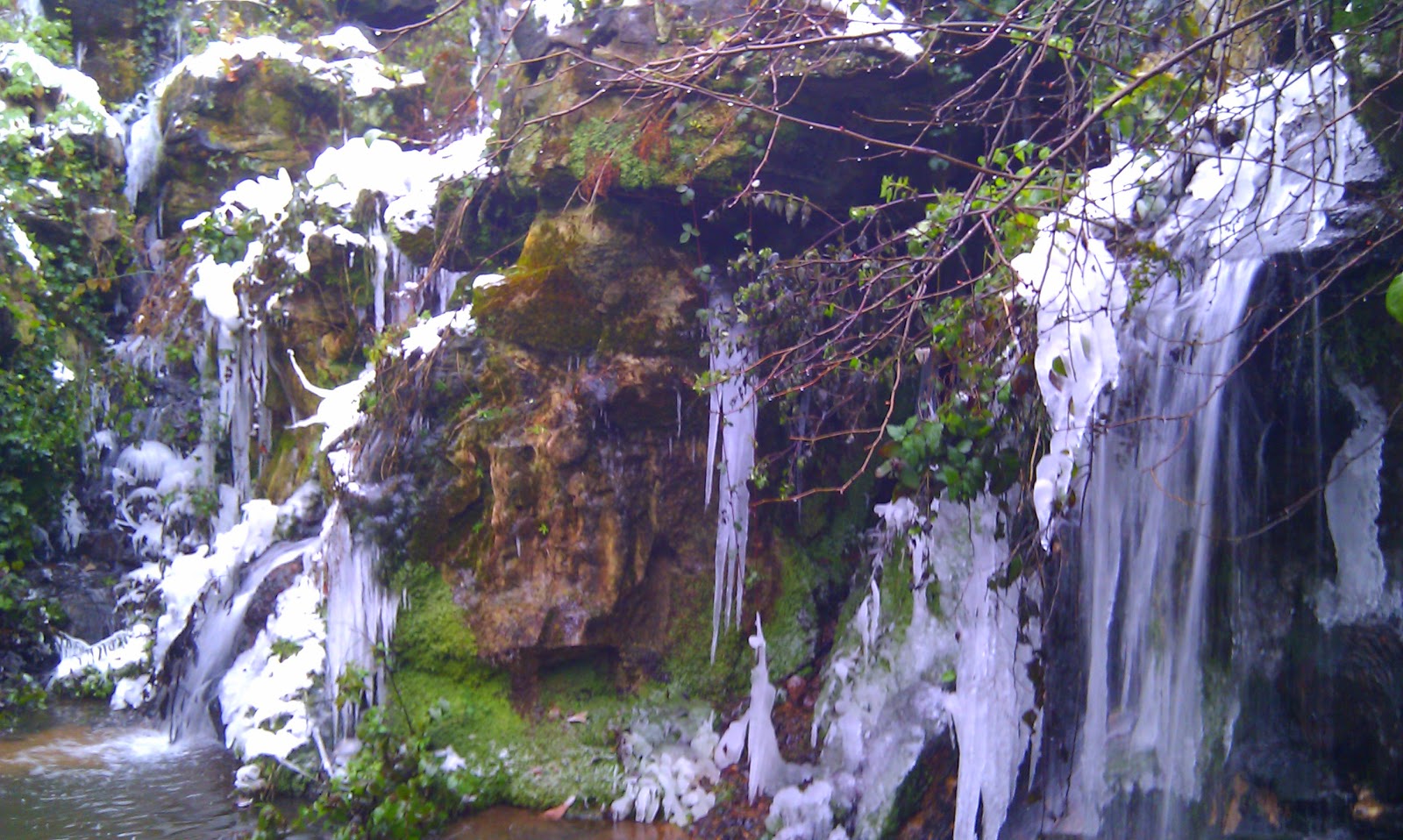
Although it had begun to thaw, there was still snow around, and icicles. Because it had begun the thaw, the green plants were showing through, and the waterfalls were flowing.
It was all very beautiful. Click here to see the full set of pictures

Tuesday, December 14, 2010

Lancaster Castle

There can rarely be an hour or five pounds better spent than the guided tour round Lancaster Castle.
It is a place of superlatives, the oldest prison still in operation, the oldest law courts, oldest prison cells, the records go on and on.  Being a law court, taking pictures was forbidden, not as matter of policy, but as a criminal offence.
We did not see much of the very oldest parts, from the time of King John, as the castle holds a working prison.  It is a small prison, a specialist centre for drug rehabilitation in the northwest, with a good record for low re-offending rates.
The Shire Hall is the jewel in the crown, built in Georgian times to house the civil court, and still in use today.  It is spacious, with rows of benches for competing teams of lawyers, and a large area for the jury to be comfortable during the long trials.  These are arranged in a semi circle and round them is an even wider terrace of seating for all the members of the public.  It is built like a theatre, because court cases were indeed a public spectacle in the eighteenth and nineteenth centuries.  When not being used as a court, the hall is used to stage plays and performances on occasions.
The semi circular back wall houses shields for every King of England from Richard I to Queen Elizabeth II. There are also smaller shields for other offices, including the Sheriff of Lancaster right up to the present day. The men and women who hold this office, for one year at time, display their ancestral coat of arms, if they have one, but mostly they need to design their own especially.
The room is light spacious and very pleasant, and we spent some time there being regaled by many interesting facts and anecdotes. I have no idea who the person in the left of three portraits hanging above the judges seats is, only that when I heard he was the second, I wanted to ask but never found a suitable moment - who was the first person to grow a pineapple in England?
The criminal court was a different affair, built in the older part of the castle, but with an impressive set of oak benches and panelling laying out the court room.  Again there was terraced public seating, but this was in a long hall, and the whole layout was more cramped. At the back of where the jury sat was a small door, through which a chamber pot could be passed, so that there was no need to delay proceedings if one of the jurors was caught short. At the back of the court the branding iron, used to mark the palm of those found guilty was still in place, long after it had ceased to be used.
On the way in to the court we passed through the jurors' waiting room, where they had the choice of the library or Star Trek videos to pass the time.  This is a pleasant Georgian room, made in the site of the much older court room, the very place where the Pendle witch trials of the seventeenth century were held.
The room where the jurors consider their verdict is a circular room, in one of the towers. It faces out of the castle into the public courtyard, and was used for public hangings in the past. It was all arranged so that hangings could take place in the rain without the executioner having to get wet.
We went into another tower, passing through a passage way cut through the ancient three foot walls, and sat in a circular room, and handled the irons used to chain men prisoners on their sixteen day walk to London before being deported to Australia. This particular ancient tower had a Georgian dome at the top, so as to fit in better alongside the Shire Hall.
The tour finished in another circular room in a tower, complete with a curved door, shaped after being made to fit the room by Robert Gillow, the famous furniture maker. Each of the chairs in this room were made by him, with individual faces carved at the top of each seat back.
Much of what we had seen was very impressive, but the tour was equally fascinating on account of the wealth of historical information and anecdotes that we were told along the way.

Saturday, November 06, 2010

HTC Desire Again

Tuesday Morning Leaves
So, what our my impressions of the HTC Desire a few weeks on?
We have annoyances, disaster, confusion, and a good experience.
Annoyances
Wednesday Morning Rose
The main annoyance is with the keyboard, hitting the wrong key.  I have sent text messages before I finished them, and cancelled entries without trying. The software helps, and corrects obvious mis-keys, but instead of offering corrections, it automatically makes the highlighted correction, so you type palmhouse but get farmhouse. It might help to have a prompt to save when you switch away from a partially entered contact or diary item. It is not good that the keyboard hides the save button, so you need to scroll down or hide the keyboard to find it, but it is worse still when it does not hide the save and cancel buttons, and they get overlaid by the typing correction offerings. If you miss one of these and hit cancel by mistake, it can be quite annoying.
Thursday Morning Rudbeckia
Disaster
After a few days there was an update to the system software that you could download and install, from 2.1 to 2.2. After I did this the WiFi stopped working and the installed programs were lost. HTC explained was because it was not a UK unit, but supplied for T-Mobile in Germany, so the company that supplied it agreed to replace it with a UK version. It was still good for calls and texts, and I could have reinstalled the lost apps using mobile broadband, but instead I reverted to my old Motorola KRZR.  (I bought this cheap on Ebay, and all the spelling prompts were - German).
Eventually the new unit came and all is well.
Friday Morning Nasturtium
Confusion
The calendar and contacts will synch with a PC, to Windows calendar and address book on my Vista PC, as well as Outlook.  They will also synch with Google calendar and mail contacts.
But it will not de-duplicate them. Instead it retains to independent records, which you can link so that they appear as one on the list.  Then when you create or edit a contact, you have a choice whether to edit the PC synch record or the Google record.
You can synch with two different PCs but it does not distinguish between them. So it is that I ended up with all my personal contacts on my work PC, and half my diary on my PC and half on Google calendar. Confusion or what?
Saturday Morning Beech Tree
I am now very happy, and I knew how I wanted to set up the new device when it arrived. You can choose in Contacts and Calendar which data sets you want to view at any time. PC synch is my work calendar and contacts, and Google is my personal ones.
A Good Experience
So now I am happy. I have my work and personal calendars in the same place, and I can choose which to view or both. Similarly with contacts.
I have a bible, to-do list, Amazon Kindle. I have started using imap for personal email, so what I delete on the mobile never gets downloaded to the PC. Who knows, I may even do the same for work email, but then, I did choose not to opt for a blackberry.
Possibly best of all, between finishing breakfast and getting out of range of the home WiFi, I have taken a picture and posted it to Facebook for the last five days.

29 October

The canal runs north of Lancaster through Carnforth, and then touches the village of Capernwray and Borwick before running closer to the M6 again.  I joined the towpath by the Old Hall Farm, in Capernwray, heading towards Borwick, and stopped to read about the aqueduct built in 1797 which takes the canal over the river Keer. Further on the canal divides in two as it is split by an Island. I ran half way along the island, and the turned back.
a pink pig guarded the entrance
You get a much better appreciation of the gradient when you are running than when driving the car.  Old Hall farm is on one side of a ridge, while the road to the caravan park of the same name is just the other side.  After that the road drops down, running close to a row of whitewashed cottages dating from 1697, and over a bridge across a beck, which I reckon is called Swarthbeck, from the name of the house with the Oriel window just by the bridge. The road rises sharply after the bridge, but I could see the board advertising Capernwray House B&B, that comfortable Bed and delicious Breakfast that I had decided to divide with the early morning run.
The thought of heavy half term traffic at Ambleside, and a leaflet advertising the Linton gallery, dissuaded us from our tentative plans to visit Keswick, and we decided to return to Settle, to see the things we had missed the previous day.
We had not gone very far before we made our first stop. The forestry commission have land on the ridge between Capernwray and the Lune valley which is known as Lord's Lot. We did not walk very far but we did  admire the way they had enlisted the support of a pink pig to guard the entrance to the land.
Our next stop was close by as well, being the bridge over the River Lune between Gressingham and Hornby.
We parked the car near the bridge and walked across, enjoying the views up and down the river from the triangular recessed areas above each of the piers. We walked along the path up river a little, and found a stick with some interesting markings on.  On the way back over the bridge we admired the way the water swirled around the piers.
We stopped near another bridge. after missing the turn to Bentham found ourselves on the road to Ingleton but turned back to Bentham at the village of Burton in Lonsdale. After taking a few pictures there, and admiring the trees that seemed to be fir trees that turn yellow in Autumn, we stopped again to admire the view from a high vantage point looking down onto the river in the valley below.   It was very lovely and restful.
Our next stop was Clapham, which we had bypassed the day before. This looked very picturesque with the river running down the middle of the village.  Ann bought some wool in at Beckside Yarns & Crafts, we enjoyed toasted tea cakes at the Croft cafe, and we bought a scarf and blankets from Richard Sexton & Co.
We then drove on to Settle, and I would recommend anyone arriving from the South to drive along the bypass and approach it on the road from the North.  It is very beautiful with cliffs to the left, and the valley to the right, sweeping round in a wide vista in front of you.
We had seen quite a bit of Settle the previous day, and while we enjoyed the exhibition at the Linton gallery, we thought that we might enjoy the next one more.  Whether we will visit Limestone, Sandstone and Millstone remains to be seen, but we travelled onto to Skipton, stopping at Gargrave, where we visited a shop called Dorothy Ward and had lunch at the Swan Inn.
At Hornby we spotted a stick
with some interesting markings
Skipton was populated with sheep, in the same way that Liverpool is populated with penguins. They are dotted around the streets with different decorations. We got to the market just as it was closing, we saw the high street branch of the Skipton Building Society, and were impressed with the public library building.  We left visiting the castle for another day.
Ann spotted the The Coffee Mill, in Otley Street, where they take their tea seriously, and make some seriously good cakes.

Sunday, October 17, 2010

Weekend Sailing

Some folk who are thinking of buying a Wanderer borrowed my Wayfarer to see what a similar boat was like, and seemed to get a favourable impression, even though one of the bungs was broken, and the boat started filling with water!
What was worse is that the front buoyancy tank filled with water, possibly from two no longer used screw holes that are now covered with Duck tape (thank you Ian).  The result was that on Saturday the boat was impossible to move, or tip back and drain, until some serious bailing had been done.  I am grateful to Ian and Geraldine who leant their support and strength to get the boat tipped up and starting to drain. It went on draining for quite some time.
The boat was on the path rather than in the berth, which is not surprising; it is harder to move on the gravel of the berth than the concrete of the path.  What is amazing is that they managed to get the boat up the slope at all. When they told me of the problem, I did not think that much of it, as I expected to be there within a week or so. With Ann being ill last month, the boat was blocking the patch for a matter of five or six weeks. How embarrassing!
When I realised the bungs Ian had leant me were not the right shape for the fittings, I decided to buy replacements later, and sail the club RS Feva instead. There are days when no-one else is sailing at Killington, so I was glad to be sailing while Ian & Geraldine were around as well.  The winds were light, and they were making good use of the Spinnaker, which I hope to learn next season.  I packed up when they did.
Just before I left Myles arrived with a group from Sedburgh school, and I was tempted to go back out. I enjoyed watching Myles skilfully talk a lone sailor back to pick up her partner, when she had unintentionally drifted off without her.
On Sunday morning I found that the replacement bungs I had bought fitted fine, and I would not need to replace the fittings they plugged into as well. Everything was fine, except that there was no wind, and the lake was as flat as a mill pond.  This did not deter the group that had come to go canoeing, but it was a show stopper for me.
The lake was as flat as a millpond
I was at a bit of a loss, and I had not brought my walking boots with me.  I went to Kendal and bought some inexpensive ones, but I noticed walking back to the car that there was a little breeze now.  I decided to walk on Farleton Fell, but call at Killington on the way. I was just in time to see the canoeing group pack up, and there was a light pleasant breeze, so the sailing was on.
Even though the winds were light, sailing the Wayfarer is an enjoyable experience and gives a good impression of speed.   It was good to be out on the water.  It rained briefly, but I did not mind. The sun came out briefly, and it was beautiful.  I heard yesterday that there was a fishing competition today, there were certainly a lot of them, so I kept away from that shore.
I thought the wind must be getting stronger, as it was really hard to keep the boat from turning into the wind, but after a while I realised the rudder down haul had come loose.  When I took a longer look at the sail, I realised that it was not that the kicking strap was too long ( I had tied a know to shorten it) but that the goose neck, boom and mainsail were too low.  I stopped in the middle of the lake to make an adjustment, then realised it was not enough, and stopped to make another, and another. I think it was quite good by the end.
This had been my first time sailing the Wayfarer alone when there were no other people using the slipway.  It is hard work pulling it up with just one other person, and mighty hard doing it alone. I was glad to reverse the car down and tow it up the slope.
Now I have checked the diary it is nine weeks since I had the boat at Glenridding, and I was very pleased to be out on the water again.

Friday, October 08, 2010

The White Queen

I usually enjoy a historical novel, and I was pleased to learn about the Yorkist Kings, as I knew very little about the War of the Roses before I started.
One of the good things about historical novels is that they can give a credible, if some what conjectural view of why people behaved the way they did. Nobody knows why Edward IV, the first and longest reigning of the Yorkist Kings did not marry a European princess as his powerful uncle Richard Neville, Earl of Warwick "Kingmaker" wanted him to.  Philippa Gregory has a rather unsatisfactory answer as to how Elizabeth Woodville, daughter of a mere knight was able to make such a fine catch - she was a witch!
To be fair, having read a little more widely, nobody seems to have a better explanation and seem to agree that she bewitched him. Not only so, but Elizabeth herself believed herself to have the powers of a witch and be descended from the water goddess Melusina. However I still felt a little cheated that instead of a plausible explanation of character's motivations what we got was an invitation to believe in witchcraft.
Another good feature of historical novels is that you can absorb a vivid picture of what life was like while simply enjoying the story.  Here again I felt slightly short changed, coming away with little idea what life and society was like. I may be wrong, but I felt it was only after finishing the novel that I read that her brother Anthony knew William Caxton and was the author of the first book to be printed in the English language.
Having said all that it was an enjoyable story and a good read. Its just that I expected more. Of course she had to skirt round one the greatest historical unknowns of all time. Who killed her two sons King Edward V and  Richard, Duke of York - the princes in the tower?  Well it remains a mystery - but the story does convey a couple of twists that are unexpected but certainly within the bounds of possibility.
Now I did come away from the story with more respect for the Yorkist kings than I had when I started, but the book is by no means pro Yorkist. In fact it is quite open about how dishonourable they were at times.
The story is much more about Edward IV than Richard III, but Richard comes over in quite a good light, especially compared to how we see him from Shakespeare's writings.  Calculating, decisive, yes, but cruel vindictive, no, and quite personable and an attractive character.   Elizabeth herself, the central character, is the more scheming and vindictive.
So there you have it, turbulent times, vividly portrayed, families at war, danger hatred and revenge, witchcraft but still accurate historically, loyalty and hope.  Not a great read but certainly a good one.