Saturday, January 15, 2011

Woman in White

Back in the day, before mobile phones, before any sort of phones, you could send letters and know they would arrive the next day, and send messengers if the other person lived close enough.
The year was 1851, when a promise to be married to someone was not something you would contemplate reneging on just because you had fallen in love with some one else in the meantime.

The technology was different, some of the values were very different, but crime was still crime.  It's said that Woman in White, written by Wilkie Collins in 1861 was the first detective novel, but I think it is more than that. We are puzzled as the story plays out not by who did it? There is very little doubt who are the heroes and who are the villains. Rather we are intrigued in wondering what did they do? and how? and will there ever be proof?

The characters are closely observed and clearly drawn, but would you expect anything less from the drawing teacher who tells much of the narrative?   Actually the narrative is told by various characters, so there is a mixtures of styles and personal observations.  This adds to the feeling that you know the character of the various parties to the story.

Some of the minor characters tell their story in a way that is very comical, adding a touch of light relief to the story a it unfolds. The solicitor tells his part quite factually, but succinctly. His part is important, as property rights of women play as large a part in this as any Jane Austen novel.

Even with the change of styles, the story zips along and is quite readable; you get the story rather than commentary on the story and life in general that seem to make other 19th century novels hard going.

There is toward the end a very unexpected co-incidence of circumstances -  Ann used the word contrived - but the story is none the less good for that.

Indeed at the end all the loose ends are tied up, and we are left feeling good, and having enjoyed the company  of a wide selection of characters.

Friday, December 31, 2010

HTC Desire Annoyances

Make no mistake.  The HTC Desire is a great phone.  The annoyances are real, but they detract very little from the overall experience.
I will add to this post, the most recent comment was made 14 January 2011.
I am using Android version 2.2 (software number 2.29.405.5)

Calendar.
  • When on a month view, you swipe from left to right to move forward a  month, and right to left to move back. When on a day view, it is the other way round.
  • On a day view, it displays the date, but not the day of the week.
  • When selecting which calendars to display the option is three clicks away (Menu > More> Calendars). It could easily be two clicks (Menu > New Event) is not needed as each screen has a "+" button, and could be one click, as Agenda and  Month each have a title called "Calendar" which could be a button.
  • Event details show the date, but not the day of the week.
  • Events would be better to have a "Edit Event" button in the same way that contacts have an "Edit Contact" button.
Contacts (HTC People)
  • The best feature of the phone, being able to start typing a first name or last name and getting all the partial matches, is not available in the contacts, which is a shame. You have to scroll up and down, the option of typing (say) P to start viewing part way down just is not there. (Oh yes it is! Just hit the find button)
  • If the address is long, you cannot see the whole of it. it is cut short, so you cannot see the postcode, the part you most likely need to look up. Clicking on it does display the whole address, but only briefly, as it makes a Google map search. The best way of seeing the postcode is to select edit.
  • It is a good feature to click on an address and see it on the map, but beware addresses with house names.  My brother's house is called "Cornerstone" and instead of searching on the postcode, it searches instead for businesses called Cornerstone in the surrounding area.
  • When looking at the list of contacts, it is not possible to see contact type, or which contact book they belong to, (with some reason, as it may be a composite of two linked records of different sources)
  • When looking at an individual contacts, the contact type is shown, but immediately overwritten by the link icon if the contact is already linked, or has an non responded to link suggestion.
  • When editing a contact, there is no indication of the contact type. Taking the last three points together, it is quite confusing.
Phone
  • The call history shows name number date and time but not duration.  Duration is available when viewing all calls made to a contact, but not calls made to all contacts by date.
  • It is very easy to make inadvertent calls when viewing call history. Tap and hold will give you a choice of actions, but tap and hold for not long enough will start to ring, as will a gentle brush of the finger.
Entering Text
  • The screen is very responsive, so that many keys are registered inadvertently. But then again, that is probably better than the alternative, plus you know when it has happened thanks to the vibrate while typing feature.
  • The autocorrect feature is either off (it offers no corrections or auto-complete) or on, in which case it not only offers corrections, but automatically selects the highlighted one. So you type palmhouse, and you then have to select the option you typed, or you get the one offered; farmhouse.
  • One of the most annoying things that can happen when the suggested words overlay the screen behind, is to miss hitting the suggested word and hit cancel instead. If this happens toward the end of entering the detail of an event, it all gets lost in an instant.

Last Sailing

It was a beautiful day on Saturday 20 November, sunshine, a steady force 2 breeze, a wonderful day for sailing at Killington.  There are just two things that might have made it better.  I was the only person sailing at Killington that day, and it is usually more fun with someone else on the lake as well.
After a very enjoyable couple of hours, I brought the boat in and was intending to tie it onto the jetty. Thinking that I had come in a little too fast, I came alongside the jetty but then started getting pushed back along its length.  That would have been alright but I had forgotten about the pulley, and I ended up with the main sail pushed back against the pulley. I could not sail away, and I could not lower the main sail either.  Eventually I did get away with a tear in the main sail, but then the wind was taking me past the slipway to the weir, and with the main sail lowered I could not sail back upwind. Happily I was able to jump out into shallow water and drag the boat back to the slipway.  A sad ending to an otherwise enjoyable days sailing.

Sunday 21 November was a slightly colder day, but plenty of people around as they came for the Sunday racing.  I was going to go out in the RS Feva, but then a friend of Jack's said why not sail with him in his father's Lark. He was not very familiar with the boat, and we were still completing the rigging when the race started, but we were soon ready, and set off in hot pursuit. A minor part of the delay was adding a second extension to the tiller, with a view to leaning out.  However I was a bit hesitant to lean out too far as the boat seemed very quick to right itself when the wind dropped or was pointed closer into the wind. We ended up not pursuing the other boats, but just getting the feel of the boat ourselves.
The wind strengthened to a force 3 at times, and we had quite a lot of fun.  I had the helm for a bit, and I got the impression of a boat that was a little faster and a little more tippy than a wayfarer.  We could have started the second race, but I was a bit pressured for time, and it was getting a little cold. In the end it was a tug  of war between the cold, persuading us to go in, and the stronger breeze, persuading us to stay and enjoy the fun.

That turned out to be the final day's sailing of the year.  I was intending to come up the following Sunday, but that was when the cold weather began.

When I came back on the weekend after that, Sunday 6th December, the boat had two inches of snow, and the lake was frozen over.


It was very beautiful.

Now the seats and floor boards are stored in the shed, with the Jib, while the mainsail is still with Pete Lawson for repair.

Monday, December 27, 2010

Waterfalls & Icicles

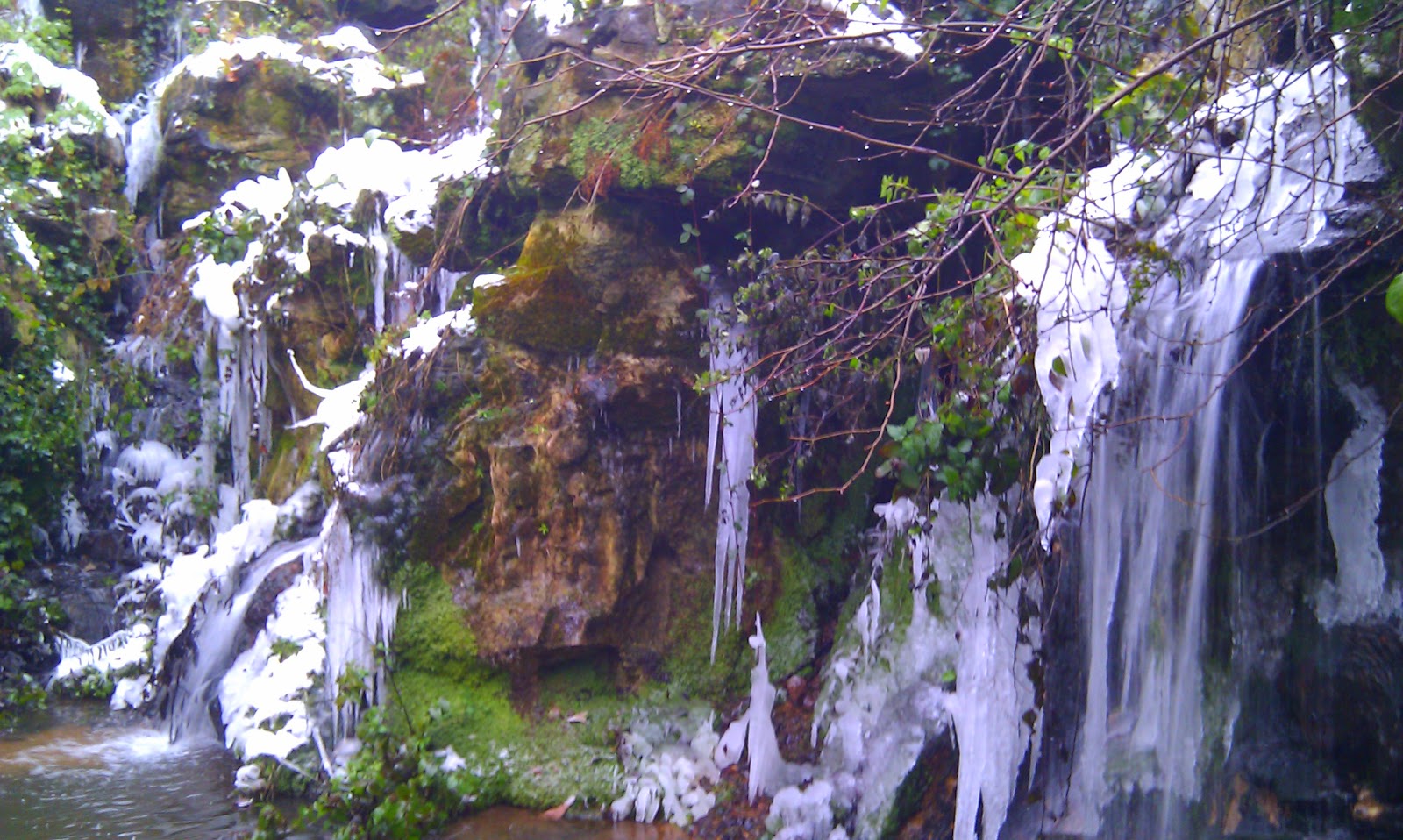
We had a great walk through Sefton Park this morning, finishing up in the Dell, or Faries' Glen by the Iron Bridge.


Although it had begun to thaw, there was still snow around, and icicles. Because it had begun the thaw, the green plants were showing through, and the waterfalls were flowing.
It was all very beautiful. Click here to see the full set of pictures

Tuesday, December 14, 2010

Lancaster Castle

There can rarely be an hour or five pounds better spent than the guided tour round Lancaster Castle.
It is a place of superlatives, the oldest prison still in operation, the oldest law courts, oldest prison cells, the records go on and on.  Being a law court, taking pictures was forbidden, not as matter of policy, but as a criminal offence.
We did not see much of the very oldest parts, from the time of King John, as the castle holds a working prison.  It is a small prison, a specialist centre for drug rehabilitation in the northwest, with a good record for low re-offending rates.
The Shire Hall is the jewel in the crown, built in Georgian times to house the civil court, and still in use today.  It is spacious, with rows of benches for competing teams of lawyers, and a large area for the jury to be comfortable during the long trials.  These are arranged in a semi circle and round them is an even wider terrace of seating for all the members of the public.  It is built like a theatre, because court cases were indeed a public spectacle in the eighteenth and nineteenth centuries.  When not being used as a court, the hall is used to stage plays and performances on occasions.
The semi circular back wall houses shields for every King of England from Richard I to Queen Elizabeth II. There are also smaller shields for other offices, including the Sheriff of Lancaster right up to the present day. The men and women who hold this office, for one year at time, display their ancestral coat of arms, if they have one, but mostly they need to design their own especially.
The room is light spacious and very pleasant, and we spent some time there being regaled by many interesting facts and anecdotes. I have no idea who the person in the left of three portraits hanging above the judges seats is, only that when I heard he was the second, I wanted to ask but never found a suitable moment - who was the first person to grow a pineapple in England?
The criminal court was a different affair, built in the older part of the castle, but with an impressive set of oak benches and panelling laying out the court room.  Again there was terraced public seating, but this was in a long hall, and the whole layout was more cramped. At the back of where the jury sat was a small door, through which a chamber pot could be passed, so that there was no need to delay proceedings if one of the jurors was caught short. At the back of the court the branding iron, used to mark the palm of those found guilty was still in place, long after it had ceased to be used.
On the way in to the court we passed through the jurors' waiting room, where they had the choice of the library or Star Trek videos to pass the time.  This is a pleasant Georgian room, made in the site of the much older court room, the very place where the Pendle witch trials of the seventeenth century were held.
The room where the jurors consider their verdict is a circular room, in one of the towers. It faces out of the castle into the public courtyard, and was used for public hangings in the past. It was all arranged so that hangings could take place in the rain without the executioner having to get wet.
We went into another tower, passing through a passage way cut through the ancient three foot walls, and sat in a circular room, and handled the irons used to chain men prisoners on their sixteen day walk to London before being deported to Australia. This particular ancient tower had a Georgian dome at the top, so as to fit in better alongside the Shire Hall.
The tour finished in another circular room in a tower, complete with a curved door, shaped after being made to fit the room by Robert Gillow, the famous furniture maker. Each of the chairs in this room were made by him, with individual faces carved at the top of each seat back.
Much of what we had seen was very impressive, but the tour was equally fascinating on account of the wealth of historical information and anecdotes that we were told along the way.

Saturday, November 06, 2010

HTC Desire Again

Tuesday Morning Leaves
So, what our my impressions of the HTC Desire a few weeks on?
We have annoyances, disaster, confusion, and a good experience.
Annoyances
Wednesday Morning Rose
The main annoyance is with the keyboard, hitting the wrong key.  I have sent text messages before I finished them, and cancelled entries without trying. The software helps, and corrects obvious mis-keys, but instead of offering corrections, it automatically makes the highlighted correction, so you type palmhouse but get farmhouse. It might help to have a prompt to save when you switch away from a partially entered contact or diary item. It is not good that the keyboard hides the save button, so you need to scroll down or hide the keyboard to find it, but it is worse still when it does not hide the save and cancel buttons, and they get overlaid by the typing correction offerings. If you miss one of these and hit cancel by mistake, it can be quite annoying.
Thursday Morning Rudbeckia
Disaster
After a few days there was an update to the system software that you could download and install, from 2.1 to 2.2. After I did this the WiFi stopped working and the installed programs were lost. HTC explained was because it was not a UK unit, but supplied for T-Mobile in Germany, so the company that supplied it agreed to replace it with a UK version. It was still good for calls and texts, and I could have reinstalled the lost apps using mobile broadband, but instead I reverted to my old Motorola KRZR.  (I bought this cheap on Ebay, and all the spelling prompts were - German).
Eventually the new unit came and all is well.
Friday Morning Nasturtium
Confusion
The calendar and contacts will synch with a PC, to Windows calendar and address book on my Vista PC, as well as Outlook.  They will also synch with Google calendar and mail contacts.
But it will not de-duplicate them. Instead it retains to independent records, which you can link so that they appear as one on the list.  Then when you create or edit a contact, you have a choice whether to edit the PC synch record or the Google record.
You can synch with two different PCs but it does not distinguish between them. So it is that I ended up with all my personal contacts on my work PC, and half my diary on my PC and half on Google calendar. Confusion or what?
Saturday Morning Beech Tree
I am now very happy, and I knew how I wanted to set up the new device when it arrived. You can choose in Contacts and Calendar which data sets you want to view at any time. PC synch is my work calendar and contacts, and Google is my personal ones.
A Good Experience
So now I am happy. I have my work and personal calendars in the same place, and I can choose which to view or both. Similarly with contacts.
I have a bible, to-do list, Amazon Kindle. I have started using imap for personal email, so what I delete on the mobile never gets downloaded to the PC. Who knows, I may even do the same for work email, but then, I did choose not to opt for a blackberry.
Possibly best of all, between finishing breakfast and getting out of range of the home WiFi, I have taken a picture and posted it to Facebook for the last five days.

29 October

The canal runs north of Lancaster through Carnforth, and then touches the village of Capernwray and Borwick before running closer to the M6 again.  I joined the towpath by the Old Hall Farm, in Capernwray, heading towards Borwick, and stopped to read about the aqueduct built in 1797 which takes the canal over the river Keer. Further on the canal divides in two as it is split by an Island. I ran half way along the island, and the turned back.
a pink pig guarded the entrance
You get a much better appreciation of the gradient when you are running than when driving the car.  Old Hall farm is on one side of a ridge, while the road to the caravan park of the same name is just the other side.  After that the road drops down, running close to a row of whitewashed cottages dating from 1697, and over a bridge across a beck, which I reckon is called Swarthbeck, from the name of the house with the Oriel window just by the bridge. The road rises sharply after the bridge, but I could see the board advertising Capernwray House B&B, that comfortable Bed and delicious Breakfast that I had decided to divide with the early morning run.
The thought of heavy half term traffic at Ambleside, and a leaflet advertising the Linton gallery, dissuaded us from our tentative plans to visit Keswick, and we decided to return to Settle, to see the things we had missed the previous day.
We had not gone very far before we made our first stop. The forestry commission have land on the ridge between Capernwray and the Lune valley which is known as Lord's Lot. We did not walk very far but we did  admire the way they had enlisted the support of a pink pig to guard the entrance to the land.
Our next stop was close by as well, being the bridge over the River Lune between Gressingham and Hornby.
We parked the car near the bridge and walked across, enjoying the views up and down the river from the triangular recessed areas above each of the piers. We walked along the path up river a little, and found a stick with some interesting markings on.  On the way back over the bridge we admired the way the water swirled around the piers.
We stopped near another bridge. after missing the turn to Bentham found ourselves on the road to Ingleton but turned back to Bentham at the village of Burton in Lonsdale. After taking a few pictures there, and admiring the trees that seemed to be fir trees that turn yellow in Autumn, we stopped again to admire the view from a high vantage point looking down onto the river in the valley below.   It was very lovely and restful.
Our next stop was Clapham, which we had bypassed the day before. This looked very picturesque with the river running down the middle of the village.  Ann bought some wool in at Beckside Yarns & Crafts, we enjoyed toasted tea cakes at the Croft cafe, and we bought a scarf and blankets from Richard Sexton & Co.
We then drove on to Settle, and I would recommend anyone arriving from the South to drive along the bypass and approach it on the road from the North.  It is very beautiful with cliffs to the left, and the valley to the right, sweeping round in a wide vista in front of you.
We had seen quite a bit of Settle the previous day, and while we enjoyed the exhibition at the Linton gallery, we thought that we might enjoy the next one more.  Whether we will visit Limestone, Sandstone and Millstone remains to be seen, but we travelled onto to Skipton, stopping at Gargrave, where we visited a shop called Dorothy Ward and had lunch at the Swan Inn.
At Hornby we spotted a stick
with some interesting markings
Skipton was populated with sheep, in the same way that Liverpool is populated with penguins. They are dotted around the streets with different decorations. We got to the market just as it was closing, we saw the high street branch of the Skipton Building Society, and were impressed with the public library building.  We left visiting the castle for another day.
Ann spotted the The Coffee Mill, in Otley Street, where they take their tea seriously, and make some seriously good cakes.

Sunday, October 17, 2010

Weekend Sailing

Some folk who are thinking of buying a Wanderer borrowed my Wayfarer to see what a similar boat was like, and seemed to get a favourable impression, even though one of the bungs was broken, and the boat started filling with water!
What was worse is that the front buoyancy tank filled with water, possibly from two no longer used screw holes that are now covered with Duck tape (thank you Ian).  The result was that on Saturday the boat was impossible to move, or tip back and drain, until some serious bailing had been done.  I am grateful to Ian and Geraldine who leant their support and strength to get the boat tipped up and starting to drain. It went on draining for quite some time.
The boat was on the path rather than in the berth, which is not surprising; it is harder to move on the gravel of the berth than the concrete of the path.  What is amazing is that they managed to get the boat up the slope at all. When they told me of the problem, I did not think that much of it, as I expected to be there within a week or so. With Ann being ill last month, the boat was blocking the patch for a matter of five or six weeks. How embarrassing!
When I realised the bungs Ian had leant me were not the right shape for the fittings, I decided to buy replacements later, and sail the club RS Feva instead. There are days when no-one else is sailing at Killington, so I was glad to be sailing while Ian & Geraldine were around as well.  The winds were light, and they were making good use of the Spinnaker, which I hope to learn next season.  I packed up when they did.
Just before I left Myles arrived with a group from Sedburgh school, and I was tempted to go back out. I enjoyed watching Myles skilfully talk a lone sailor back to pick up her partner, when she had unintentionally drifted off without her.
On Sunday morning I found that the replacement bungs I had bought fitted fine, and I would not need to replace the fittings they plugged into as well. Everything was fine, except that there was no wind, and the lake was as flat as a mill pond.  This did not deter the group that had come to go canoeing, but it was a show stopper for me.
The lake was as flat as a millpond
I was at a bit of a loss, and I had not brought my walking boots with me.  I went to Kendal and bought some inexpensive ones, but I noticed walking back to the car that there was a little breeze now.  I decided to walk on Farleton Fell, but call at Killington on the way. I was just in time to see the canoeing group pack up, and there was a light pleasant breeze, so the sailing was on.
Even though the winds were light, sailing the Wayfarer is an enjoyable experience and gives a good impression of speed.   It was good to be out on the water.  It rained briefly, but I did not mind. The sun came out briefly, and it was beautiful.  I heard yesterday that there was a fishing competition today, there were certainly a lot of them, so I kept away from that shore.
I thought the wind must be getting stronger, as it was really hard to keep the boat from turning into the wind, but after a while I realised the rudder down haul had come loose.  When I took a longer look at the sail, I realised that it was not that the kicking strap was too long ( I had tied a know to shorten it) but that the goose neck, boom and mainsail were too low.  I stopped in the middle of the lake to make an adjustment, then realised it was not enough, and stopped to make another, and another. I think it was quite good by the end.
This had been my first time sailing the Wayfarer alone when there were no other people using the slipway.  It is hard work pulling it up with just one other person, and mighty hard doing it alone. I was glad to reverse the car down and tow it up the slope.
Now I have checked the diary it is nine weeks since I had the boat at Glenridding, and I was very pleased to be out on the water again.

Friday, October 08, 2010

The White Queen

I usually enjoy a historical novel, and I was pleased to learn about the Yorkist Kings, as I knew very little about the War of the Roses before I started.
One of the good things about historical novels is that they can give a credible, if some what conjectural view of why people behaved the way they did. Nobody knows why Edward IV, the first and longest reigning of the Yorkist Kings did not marry a European princess as his powerful uncle Richard Neville, Earl of Warwick "Kingmaker" wanted him to.  Philippa Gregory has a rather unsatisfactory answer as to how Elizabeth Woodville, daughter of a mere knight was able to make such a fine catch - she was a witch!
To be fair, having read a little more widely, nobody seems to have a better explanation and seem to agree that she bewitched him. Not only so, but Elizabeth herself believed herself to have the powers of a witch and be descended from the water goddess Melusina. However I still felt a little cheated that instead of a plausible explanation of character's motivations what we got was an invitation to believe in witchcraft.
Another good feature of historical novels is that you can absorb a vivid picture of what life was like while simply enjoying the story.  Here again I felt slightly short changed, coming away with little idea what life and society was like. I may be wrong, but I felt it was only after finishing the novel that I read that her brother Anthony knew William Caxton and was the author of the first book to be printed in the English language.
Having said all that it was an enjoyable story and a good read. Its just that I expected more. Of course she had to skirt round one the greatest historical unknowns of all time. Who killed her two sons King Edward V and  Richard, Duke of York - the princes in the tower?  Well it remains a mystery - but the story does convey a couple of twists that are unexpected but certainly within the bounds of possibility.
Now I did come away from the story with more respect for the Yorkist kings than I had when I started, but the book is by no means pro Yorkist. In fact it is quite open about how dishonourable they were at times.
The story is much more about Edward IV than Richard III, but Richard comes over in quite a good light, especially compared to how we see him from Shakespeare's writings.  Calculating, decisive, yes, but cruel vindictive, no, and quite personable and an attractive character.   Elizabeth herself, the central character, is the more scheming and vindictive.
So there you have it, turbulent times, vividly portrayed, families at war, danger hatred and revenge, witchcraft but still accurate historically, loyalty and hope.  Not a great read but certainly a good one.

Monday, October 04, 2010

Lyme Regis

Three years ago I was slightly disappointed with Lyme Regis, but this year we really enjoyed it.
We stopped at Charmouth on the Monday morning, and went to the Open Air market, where I bought some Regatta trousers and some walking shoes for Anna.  There is no bank there, so I drew out some money from the post office.
I dropped the family at the little car park by the museum, it is basically a roundabout with parking spaces round three sides, you are lucky if a space comes free. The drive in gets quite narrow at points, the lights are not because there is a junction, but rather the road does not take two way traffic at the corner. There are other points where the road is marked keep clear, and if drivers do not it gets quite awkward when the bus comes the other way.
There is plenty of space at the car park, and it costs only a pound all day, and there are toilets.  Best of all there is a wonderful view of the town the bay and the blue and green waters sparkling in the sunshine.  There is another car park, by the fire and police stations, but you have to drive through some narrow streets busy with pedestrians, it is more expensive and hardly any closer to the beach.
From the bottom of the hill, the promenade leads to the harbour and the Cobb, Broad street has all the shops, and the narrow road leading inland follows the river Lym past the mill and other parts of the town.
We ate at the cafe de Sol, on the terrace overlooking the river. There were no free tables inside, so we huddled under a parasol from the shower, but by the time we had decided what to order the shower was gone and the sky was a bright blue, a beautiful day.
After lunch we explored the area around the mill. I went on the guided tour of the mill, which was very informative. It generates its own electricity, and it mills flour using the water wheel. When I rejoined the family they were in one of the buildings near the mill which was being used as an art gallery. We bought pictures by a local artists Jan Callow and Barbara Green.
Later John and I walked across to the harbour and out onto the Cobb, the stone jetty made famous by John Fowles novel and the film The French Lieutenants Woman.  It was very impressive.  The waves were quite strong, splashing up onto the cobb, while the harbour and the beach enjoyed the shelter it gives. Past the promenade some shallow rocks stretch out to sea, so that the waves were breaking over some distance and the rolled in. It was late afternoon at this point, the sun was getting lower, and shining on the coast and cliff stretching out past Golden Cap and round the bay. It did look very golden.
We came to Lyme a second day, and we spent some time in the shops on Broad Street. The book shop at the bottom held my interest the best, though it would have been useful to remember that the convenience stores stay open longer than our local Londis in Chideock.  The weather was less bright that day, and Anna John and I went walking past the harbour onto the Shingle beach beyond.  It took good notice of the sailing club compound, and on the way back got chatting to someone packing up his Wayfarer, and helped him free his lanyard that had got caught inside the mast.
We had one night time trip to Lyme, when we had a sit down meal eating fish and chips at the Lyme fish bar.  Then we went for a walk along the promenade, and Kim took some pictures of the moon and its reflection over the water.

Wednesday, September 29, 2010

Pennies from Heaven

For the next six days you can go to the BBC Radio4 page for yesterdays Afternoon Reading Penny's from Heaven.
It is a beautifully crafted 15 minute short story written by Anneliese Mackintosh.  The jokes are well sign posted, and had me laughing out loud moments before they were delivered.
It is a slightly sad, gentle, very credible story, that I thought was good fun.  It is part of a series of three by different writers that continues today and tomorrow.

Wednesday, September 15, 2010

HTC Desire

So what are my impressions after just five days?
It is very nice. It is light and thin, with a large bright vibrant screen, with an excellent viewing angle. Most of the front is screen, with fairly small bezel, and just five buttons below the screen. The camera remains largely untested, but my one outdoor shot was frighteningly easy to post on facebook. Viewing pictures on screen is great, being able to zoom and pan.  It also plays music passably well, a  little tinny but passable through its own speakers, and fairly indistinguishable (to my ears) from the iPod played through speakers. Using the internet is a worthwhile experience, you would always reach for a laptop if one was available, but you can certainly read information quite adequately. Using Google maps is still to be experienced.
What about address book calendar texts and calls?  Well the good news is that the HTC Sync software works with Windows Mail address book and calendar, not just Outlook. (I am talking about the ones I have on Windows Vista, I am not sure about the Windows Live mail in Windows 7).  The other route to synchronise data is with Google mail address book and Google calendar, which happens when you sign into google mail from the phone.  The calendar seemed to cope with events appearing from both directions.  The address book ends up with duplicate entries, with an option to link between them. Linked address book entries retain their separate identity, so that when you edit, (or add) you have to chose to operate on the sim, the phone or the Google account.
The phone itself uses the HTC fast dial, which is great, as you can type a number or a name, and the screen offers the names that match as you type, although scrolling through the address book and dialling is also very easy.
Texting has been my biggest problem, not on account of the application, which shows both sides of the conversation very nicely, but on account of the keyboard, and clumsy fingers. I unwittingly invited two work colleagues to Sparklers (Sunday school) - attaching a calendar event to text message is easy, deleting an attachment is a skill I have yet to master.  What I do wish I had learned sooner was that the middle (scroll) button is a much easier way of moving the cursor than a finger on the screen.
There are annoyances that remain. The combination of hard buttons and on screen buttons can be less than intuitive, and the back button is inconsistent between back one or multiple steps. I am not sure whether switching away from an application leaves it running in the background or closes it. Certainly switching away from entering or editing an address book entry aborts the operation; you have to press save even if its is hidden by the keyboard or you have to scroll down to find it.
The market place is good. I found a very creditable bible reader and NIV bible for USD 5.99, and quite  a competent todo list that I will probably pay USD 2.95 for, to stop the adverts in the free version.
One important matter that it handles very well is switching on and off wi-fi and 3G mobile connection, nice to have no ambiguity there.
Emails? Yes. I logged into by pop3 account and google mail no problem. I have not explored push email, and have no great wish to. If I wanted to, I guess I would have got a Blackberry.

So, the first impression is of a phone that has a wonderful screen, is largely competent in most areas, has a lot of very nice features and a few annoyances that I can learn to live with.

Sunday, August 29, 2010

Colmer's Hill

We pass several hills driving from Chideock to Bridport, none more distinctive than Colmer's Hill, rising steeply to the summit with nine trees at the top, making it look very inviting.
John and I were very pleased to reach the top on Thursday.

We started in the village of Symondsbury. At the right hand bend before the church, the no through road ahead is only closed for traffic, but open to pedestrians.   The track leads to North Chideock, and is called Hells Lane.

I learnt from a TV program recently that this is a Holloway, and ancient track used by Cattle drovers, and the sandstone is worn down by use over the centuries, so that the path is flanked on both sides by sandstone walls.  At one section the walls must have been twenty foot or so on either side.  It was very beautiful.  We walked half way to North Chideock before we turned back across the fields to where there was a very clear footpath leading to the summit.

The view from the top was impressive.  We counted all nine trees, including one that was cut short at the first branch, and noticed that quite a few saplings had been planted round the summit, so that the hill may look very different in a few years time.
   We picked out Eype Mouth, which cuts through the hills between us and the sea, and Sloes Hill, just the other side of Symondsbury, and Allington Hill, on the edge of Bridport. Looking North we picked out Park Copse and Henwood Copse, but the hills were not so easy to identify.  It was all very beautiful.

We came down on the South side of the hill and across the field back to the lane where we started.  It was not very clear where to leave the field, but when we found the gate we read the notice which explained the path was a permissive path, and would be closed for ten days each year.
Earlier in the week, we visited the pottery at Symondsbury, and bought a mug that had a depiction of the hill as decoration.

Saturday, August 07, 2010

Week at Glenridding

Now that I have a combi trailer I can sail on different lakes, and my first journey was to Glenridding, where I learnt to sail last summer.
Pete & I had already fitted the launching trolley onto the road trailer, and the main task was to take down the mast, a job probably made easier by the branches of the trees, which meant the mast was supported to some extent at the top.  I would have got some help from a water board employee who arrived to check the water levels, but I found I had to disconnect the kicking strap from the boom, and did not like to keep him waiting.
The next task was a journey to Kendal to buy an extension for the tow board electrics, as my 12ft cable was not adequate for the 15ft boat. Having found the retail park at the South, the people at Homebase were able to point me to the one in the north, where Halfords is on the road leading to Shap.  Back at Killington I had to pull the boat with the car, as one of the road trolley wheels seemed reluctant to move from its rut in the gravel which covers the surface of the berth area.
The journey via Penrith and down the west side of Ullswater took an hour. I travelled at 60 on the motorway, and overtook just two vehicles, an old VW camper van and one truck just before Penrith.  It all went smoothly although I did find when I arrived that the bolt keeping the two trolleys together was partially undone and sticking out at an angle.
I managed to set up the mast OK, but did put a dent in the corner of the car roof as I lost control at one stage. I asked for help getting the launching trolley off the road trolley.  It was then time to set  off to rejoin Ann for the evening, so no sailing on Monday.
Tuesday was nice sailing, a fairly happy force 2, and nice sailing from about 11.00 till about 2.30pm.
On Wednesday & Thursday I was joined by Wendy. Wendy tried the helm on Wednesday but the gusts and variable wind direction were a bit much. At one stage we followed another Wayfarer, and were puzzled by their change of direction, but when we got to where we were we did just the same.  We followed them on a course turning 270 degrees, while sailing close hauled on a starboard tack the whole time. Such are the variable winds from the valleys round Ullswater.
Wendy was at the helm the whole three hours on Thursday, and took to it very well. The main problem that day was two episodes sitting in areas of the lake where the wind had dropped altogether, but they were not long lasting.  We raced against a Seafly at one point, very close around Norfolk Island, and then we won getting to the one near the sailing centre. It was actually very difficult. A starboard tack took you to the shore opposite the sailing centre, as the wind came from the south, and a port tack took you back down the lake as you caught the wind coming down from Glenridding valley. Without the challenge of the race we would probably have stayed out nearer Norfolk Island.
Friday did not look particularly inviting weather, but Pete said it was a good wind, steady and not very gusty. Ellie arrived at about 11.00 and soon we were out on the water not noticing whether it was raining or not. We each had a share of helming in force 2-3 winds, and we sailed close to one of the Hawk 20, the one with a cabin.  Then the wind stiffened to a force 4, and it was quite fun. It was quite noticeable that the balance of the two sails was well behind the pivot point, and that I had to pull the tiller quite hard in the strong winds to stop the boat turning to windward.  We raced around with very little other craft to be mindful of.
We could have done with tightening the kicking strap in the stronger winds, but we had another problem caused by the strong winds, which was the goose-neck, very happily lashed to the mast in a force 2 or 3, started to work loose and we then found that the boom was no longer attached to the mast.  Ellie was helming at the time, so we swapped around and sailed away from the island, and Ellie did a passable job at tying it back.  It held fairly OK as we made are way back to the sailing centre and we brought our exciting session to a safe close.
Later they fished out a goose-neck that had brackets to clasp onto the mast, so we made a swap and I am looking forward to trying out the new one soon.

Sunday, July 25, 2010

Drawing

Ann said before the start of the holidays that she wanted to draw a picture each day of the holidays. I am not sure she has managed it, but I joined her on the table this afternoon and this was the result.

Combi-Trailer

I had a great afternoon yesterday sailing the Wayfarer single handed in a force 3 wind at Killington. The boat zipped along very nicely, and I had no idea that 2 hours had passed when I came into to sort the problem with the goose-neck.
I went up simply to swap the boat from the original trailer onto a second hand combi trailer I had bought. Pete Lawson was teaching a level 2 safety boat course, so it was quite comforting to know that there was a safety boat on hand. They were the only other people there when I arrived, although a couple arrived after me and took out their Enterprise later on.
When Pete had finished teaching, he showed me how to attach the launching trolley to a tow bar, which makes it easier to get up the ramp, and how to load the launching trolley on the road trailer. I may leave it off the road trailer most of the time, as it was a little awkward.
We also ran through the procedure for taking the mast down. 1. Make the boat level, 2. undo the side shrouds, 3. undo forestay keeping it tight until you can get in and hold the mast, 4. secure the stays to the mast with tape, 5. lift the mast and place it on the ground, 6. hold it vertical against the side of the boat as you get out, 7. hold the bottom in place with a foot as you lower it to horizontal. It is easier with two people at 3 5 6 & 7.

Dragon Tattoo

This is a cracking book and a good read.  I have not seen the film, but enjoyed the book very much.  It is the first of the Millennium Trilogy by Stieg Larsson.
The central story concerns a teenage girl who disappeared half a generation ago.  Her uncle is convinced she was murdered by one of the family, who is continuing to taunt him by sending a pressed flower on her birthday each year.
Mikael Blomkvist is engaged to re-investigate the mystery while ostensibly working on a chronicle of the family history.  His story, and that of the Lisbeth Salander, the girl with the dragon tattoo are wrapped around the central story, as they agree to work together on the investigation.
For the first half of the book their stories are quite separate. Mikael runs a financial journal, called Millennium, which gives the trilogy its name, and faces a prison sentence when he is unable to defend the magazine against a libel claim.  Lisbeth's story is all the more shocking, and all the more so due the the juxtaposition of the two stories in the text at certain points.
There are some gruesome crimes in the book.  They are grim, but the presentation is not unnecessarily gory. Similarly, there are sex scenes, but the telling is not salacious. They are just part of the story.
It is a satisfying story, with no obvious loose ends, but clearly some threads that get picked up in the following books. Whether you go on to read the other two or not, this is an enjoyable book.

Wednesday, July 21, 2010

Wild Sailing

The wind was quite wild last weekend.
On Saturday I sailed the RS Feva at Killington. I stayed close to the clubhouse sailing on a beam reach across from one side of the lake to the other. It was quite fun. It was a little difficult getting it to turn and a few times I was blown back onto the tack I was just turning from.  I got the hang of tightening the main sale and being quick to tighten the jib after turning.  
After about an hour I capsized, my first time in the Feva. It came up OK, but then it went over straight away.  The second time I got on OK but capsized again quite soon afterwards. This time it did a total inversion and I was getting quite tired. After a bit I was sat on top of the upturned boat again, resting to get my breath back, and thinking that the vague thought that it might be foolhardy to take a boat out when no-one else was around that I had before I started was beginning to feel a bit more real. I began to wonder which bank I would end up drifting onto.
Once I got my breath back I got the boat upright again, but did not have the energy to clamber back onto it.  I held onto the side while it sailed to the side, just downwind from the clubhouse. I was very glad to be able to pack up the sails and walk the boat back to the jetty.
Some one else did arrive as I was walking the boat back, and after I had got changed and had some lunch and was about to leave, a couple arrived to go windsurfing.   Windsurfers like the strong winds.
When I arrived at Killington on the Sunday, the only people there were just taking some boats away, so I drove on up to Glenridding. Pooley Bridge was in bright sunshine, and the middle section of Ullswater looked very windy. I arrived at Glenridding just as some folk were leaving after a great time on the Laser Stratos, that ended with needing to be rescued, and Pete said to leave it for five minutes to see what the wind was going to do next. 
I went out on a Topper Topaz, and it was great fun. I was going across from one side of the lake to the other on a beam reach, and it did not take long to get from one side to the other.
The sheet tended to get caught in the cleat without really trying, which concerned me a bit, and like the day before I found it was difficult to turn all the way through a tack. I ended up in irons a few times, but it turned easily enough by lifting the dagger board. After a while I started sailing closer to the wind on the starboard tack, and nearer a broad reach on the port tack. I expected the broad reach to seem quieter but the boat seemed to be zipping along at great speed. It was certainly lots of fun.
I capsized after a short while, as I kind of expected to when I opted not to reef the sail. Then after about 45 minutes I capsized again.  I recall this well, it was just on coming out of irons again.  This time the boat capsized immediately after I righted it, and then again shortly after I had climbed back on.  The lads in the safety boat explained that I had the sheet in the cleat, and they waited nearby to see if I could resolve it.
I did try again, but this time I was getting quite tired, and I was very glad they were nearby as my last attempt failed and I found the boat drifting away from me.
Later Steve showed me how to remove the sheet from the hook near the cleat altogether, which I will remember for next time.  He also explained how to lift the sail briefly out of the water repeatedly until the wind is coming from behind you, before bringing the boat upright.  Righting a capsized boat, so easy in a force 2 wind, does seem to be more challenging in a force 4, and not one that I can say I have mastered yet.
It was great to be rescued, get changed, and enjoy a nice lunch in the sunshine looking over the lake.
Some folk were taking a catamaran out, and that was certainly displaying a very impressive turn of speed. 

Saturday, June 26, 2010

Killington & Windermere

Last Saturday was very windy, force 3-4 with stronger gusts.  So I went out in an RS Feva, one of the club craft at Killington, rather than risk capsizing the Wayfarer, which is easy enough to recover, but a pain to empty of water afterwards.  I nearly went in the Pico, as there were two lads preparing to take the Feva out, but in the time it took me to get changed, they had launched, capsized, floundered, been recovered, and were packing up.  They were just about to take it back to the berth when I asked them to leave it there for me.
It was a while before I got out on the water, as I wanted to have the mainsail only, and there was no forestay, and it was only the jib acting as the third stay.   Thanks got to Miles and Paul for sorting this out for me. Killington is indeed a very friendly and supportive sailing club.
Pete was there as well, but he was OOD (Officer of the day) for a series of Miracle Dinghy races.  Miracles are a little like Mirrors, but bigger, and they seem to have most of the advantages of a Wayfarer, except for cruising, where there was less storage space, but lighter and with transom flaps, making for easier emptying after a capsize.  All of them were timber, or at least timber decked, but I am told there are GRP ones as well.  There were a couple of boats still on trolleys in the car park, as the owners had looked at the wind conditions and decided not to go out in them.  During the day I met Ian & Geraldine for the first time, Ian is the membership secretary, and Lydia another committee member (I think) who was helping Pete.  I missed being sociable when the racers were having their lunch break, as I had only just got out on the water by then
The sailing was great.  The wind had probably dropped a little, but it was still quite strong and very gusty, providing quite a bit of excitement. For all the Feva feels more tippy than the wayfarer, it felt very secure in the gusts, with time to sheet out or turn to the wind to control the heeling, with no sense of being out of control.  I have yet to discover how easy it is to right a capsize.  What I did struggle with twice was being late straightening the boat after a turn, and continue to pivot round. I certainly got knocked on the head at one stage after going about, when it continued turning and the boat jibed.
After lunch the wind eased and I went out with the Jib as well.  More thanks to Miles and Paul again. Altogether a great day.

Sunday was much more relaxed, and Rod who had sailed with me in May joined me again. When we got to Killington, it was a pleasant surprise to see Dave waiting for me, as I had not been on facebook on Saturday to see his message. We decided to go to Bowness, to sail in his Wildfire on Windermere, which was a very different experience.  Windermere is a beautiful lake, and was at its best in the bright sunshine we enjoyed on Sunday.
The boat took a bit of time to set up, and when the mainsail would not reach the top of the mast we decided to put a reef in rather than spend further time trying to right the problem.  Dave kindly let me helm to start with, and we made our way upwind to the South getting past Storrs Hotel before turning back, and then eating our lunch while sailing downwind.
The Windfire has a good turn of speed, which was especially evident every time we got some slightly stronger wind, and even with the reef in we kept up credibly well with the handful of yaughts that were out and about and under sail.  Rod, who was sat at the front, did find that the water was splashing over the bows when the wind grew stronger and we were sailing upwind.
One feature of the Wildfire is that it would be very easy to sail single handed. The jib sheets run along way back, and are in easy reach of the helm.  Dave did a much better job of keeping out of my way than I managed to do when he took over the helm, and after a while I joined Rod sitting in the front.
By Sunday afternoon we were by no means the only dinghy on the water as we seemed to be in the morning.  There was a whole fleet of dinghies from nearby club out enjoying Windermere at its best. What a great way to enjoy a beautiful Sunday afternoon.  Thanks Dave, for a great day.

Sunday, June 13, 2010

Super-sing

Yesterday afternoon we went to the Super-sing concert at the Liverpool Philharmonic Hall.
We had gone to hear two choirs brought together by the super-sing series. One classic choir and one Jazz choir each sang about four pieces that they had rehearsed during Thursday evenings during the previous six weeks.
Before the interval the orchestra played some Aaron Copeland and three movements from the planets.  It was a large orchestra, comprising probably three quarters from the philharmonic orchestra and one quarter amateurs who wanted to give it a go. They had only come together as an orchestra that morning, but whether this was preceded by six smaller rehearsals I do not know.  The friends we had come to hear were in the Jazz choir.
The audience was probably made up exclusively of family and friends of the performers, and the hall was comfortably full, but not packed.
The singing was a lot of fun.  We were invited to join the classic choir in their warm up exercises, and then treated to very good performances of Verdi and Vivaldi. There were probably about one hundred in each choir.
The Jazz was accompanied by piano drums and double base, each of which had solo spots on occasions, and were very good.  Some of songs has solo part sung by the conductor, and sometimes the choir was centre stage,  at least one time the instruments stopped and they were singing Al Capella. The conductor had us joining in at points. The Music included Blues, Duke Ellington and Ray Charles. It was a very enjoyable program and good afternoon.